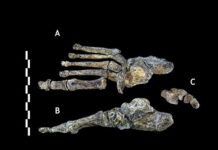
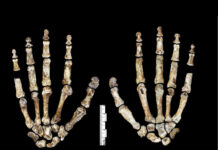
According to a study published by the Royal Society of London, hominids developed the ability to walk upright 3.7 million years ago . The group of scientists has based their conclusions on prehistoric footprints located in Tanzania.
The vestiges found in the Laetoli site (Tanzania) , have led experts to determine that the Australopithecus afarensis that populated the region at that time, supported their weight on the forefoot, as we humans do today. In this way, and as proposed in the research, these hominids walked upright and not stooped like chimpanzees or gorillas, which support the weight in the middle part of the foot.
The computer simulation has helped scientists to represent the footsteps of the ancient inhabitants of the area, although it has not avoided the controversy. The age of the footprints preserved in mud when covered by volcanic ashes, has caused that over time they have been deformed, generating debate among the scientific community about the conclusions that have been obtained from them.
While hominids began walking on two limbs around six million years ago, some researchers argue that the human form of gait, bearing weight on the forefoot, began with Homo erectus nearly two million years ago. The analysis of these remains argues that Australopithecus afarensis walked more like a modern human being than any bipedal primate.