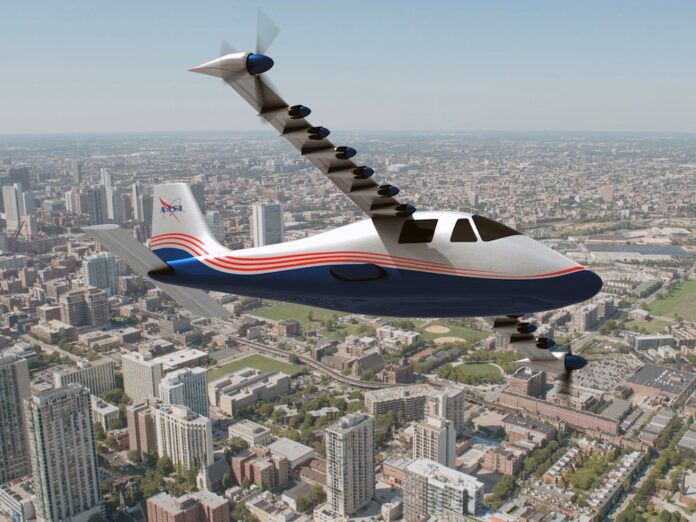
NASA has announced that it is going to begin flight tests of the X-57 “Maxwell”, a single-wing electric experimental aircraft in which 14 propeller thrusters are integrated: 12 for takeoffs and landings and one larger in each tip for cruise flight.
The space agency hopes to prove that this innovative distribution of electrical power reduces the energy requirements of a device moving at an average speed of 280 km / h by a fifth.
The X-57 runs on electric batteries, which eliminates most carbon dioxide emissions and considerably reduces noise pollution. NASA’s goal is to prove that non-fossil-fuel aviation is possible.
Its engineers maintain that this aircraft stands out for its enormous efficiency in the cruise phase of flight. Compared to others of its size, it reduces operating costs by 40%. It must be taken into account that, in order not to run out of fuel, a conventional aircraft must fly at a lower speed than it can achieve. In electric aircraft, this problem disappears and you can fly at full throttle all the time, which will reduce the duration of the trips.
Will we see the X-57 technology in large passenger jets? Not yet, according to NASA administrator Charles Bolden. However, Bolden says that “the agency’s return to piloted aircraft testing and the development of the X-57 open the doors to a new era of aviation.”
The device is nicknamed “Maxwell” in honor of the physicist James Clerk Maxwell (1831-1879), who demonstrated that magnetism, electricity and light are manifestations of the same phenomenon: the electromagnetic field.
If you want to delve into NASA’s electric propulsion projects, stop by here.
Illustration: NASA Langley / Advanced Concepts Lab, AMA, Inc.