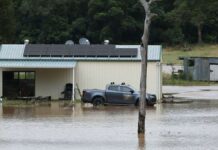
The Bundesbank in Mainz has a lot to do: More than 50 million euros have to be cleaned by specialists after the flood disaster.
Mainz – In the flood disaster in North Rhine-Westphalia and Rhineland-Palatinate in July 2021, insurance losses of around seven billion euros are expected so far. Heavy rain and floods caused the low pressure area to destroy or damage houses, household effects, businesses and motor vehicles. According to the General Association of the German Insurance Industry (GDV), the flash flood was the historically most damaging natural disaster in Germany. The federal government had launched a reconstruction fund with a volume of 30 billion euros *.
But not only this property damage has to be reported after the disaster, large sums of cash are now also being submitted for reimbursement: the Bundesbank exchanges the money – to literally launder it. More than 50 million euros, often polluted with sludge, sewage and heating oil, have so far been submitted for reimbursement by private individuals and savings banks. The banknotes are washed, dried and checked by specialists from the Bundesbank in Mainz.
Money becomes “hard as concrete” – those affected should submit the notes quickly
If you are also “allowed” to call dirty money your property, you shouldn’t wait too long before submitting it. Bundesbank board member Johannes Beermann at the analysis center for counterfeit and damaged money explained: “The bank notes must be processed as quickly as possible before they clump together and become hard as concrete.”
The dirty and foul-smelling bundles of money are delivered shrink-wrapped. Specialists then, with great care, wash, dry and straighten them. Then the notes are checked and counted again.
Flood disaster: no chance for counterfeiters
Citizens can use this service free of charge. The submitted amount will be registered and reimbursed. Two conditions apply: Firstly, at least 50 percent of each damaged banknote and “one more snippet” must be present, as Beermann explained. In addition – not surprisingly – it must not be bottle money. The check leaves counterfeiters “no chance”, says Beermann.
Private individuals can either submit their “flood money” directly to the Bundesbank, hand it in to their commercial bank or send it by post. The total number of damaged notes submitted so far exceeds the annual average due to the flood disaster by far: Usually, 40 million euros are submitted to the analysis center each year. (Nadja Austel / dpa) * fr.de is an offer from IPPEN.MEDIA.