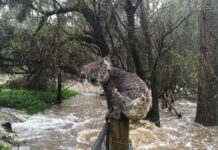
Tens of thousands of koalas have been killed or injured in bushfires in Australia. In general, their population is declining dramatically in many parts of the country. Now the government is taking action.
Sydney – In Australia, the koalas are in danger and are now better protected in large parts of the country.
In the states of New South Wales and Queensland as well as in the Australian Capital Territory with the capital Canberra, the endangerment status of the funny marsupials is officially increased from “vulnerable” (endangered) to “endangered” (endangered), as Environment Minister Sussan Ley announced on Friday. Persistent droughts, devastating bushfires, disease and habitat loss have led to a sharp decline in the koala population over the past 20 years.
The government wants to spend 50 million Australian dollars (31 million euros) over the next four years to protect the animals. “We are taking unprecedented action to protect the koala and are collaborating with scientists, medical researchers, veterinarians, communities, states, local governments and indigenous people,” Ley said.
In particular, the massive bush fires from August 2019 to March 2020 hit the cute marsupials hard. According to estimates by the environmental organization WWF, more than 60,000 of the koalas that are only native Down Under were killed, injured, driven away or traumatized. Images of animals with singed fur and burned paws went around the world.
Scientific Studies
According to the animal welfare organization International Fund for Animal Welfare (IFAW), the protection status was upgraded on the basis of two scientific studies. These would have shown that the koala population in tropical Queensland has plummeted by at least 50 percent since 2001 and koalas in New South Wales are even threatened with extinction.
“The decision to upgrade the protection status was now urgent,” said Rebecca Keeble, IFAW Oceania Regional Director. The Australian government failed to take early action to protect koalas, she said. It is imperative now to secure key koala habitats, reconnect wildlife corridors and minimize key threats to the animals.
“National Icons”
“It shouldn’t have gotten to the point where Australia is now in danger of losing a national icon,” Keeble said. The koala situation must be a wake-up call for Australia and for the government to speed up its efforts. “Critical habitats must be protected from development and deforestation, and the impacts of climate change must be vigorously addressed.”
The koala – or “Phascolarctos cinereus” – is a marsupial endemic to Down Under that sleeps most of the day perched in trees and feeds solely on eucalyptus leaves. This is possible because the digestive system is able to neutralize the toxic chemicals in plants. According to the Australian Koala Foundation, there are at most 100,000 koalas left in the wild, “but probably no more than 43,000,” according to the foundation. dpa