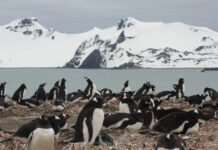
Until now it was thought that the chemical remains of lotions, creams or other similar beauty products, degraded over time and ended up dispersing in the atmosphere. Now, the discovery of small amounts of volatile cyclic methylsiloxanes in samples of soil, plants and also in krill and phytoplankton in various places in Antarctica by a team of scientists from the CSIC, proves that this is not the case.
The CSIC team, which has published its study in the journal Environmental Science and Technology , discovered this chemical substance in 2009 in samples taken in the Pyrenees area and then they wondered if it was possible that these remains had reached more remote places such as the Antarctica. An expedition set out and collected samples from a dozen different locations on the Antarctic continent using gas chromatography techniques that eventually revealed the presence of at least three types of chemicals, abbreviated as D4, D5 and D6. The most striking thing was not only its finding, but the levels found were comparable to those of the samples taken in Europe and North America .
How did these substances get to such a distant place ? The hypothesis used by scientists is based on the fact that after evaporation, these remains remained in the atmosphere where they could have mixed with the snowfall. When the snow melted on the ground, the products returned to the ground, being able to reach plants, the sea, or assimilated by phytoplankton.
Does this pose a risk to the environment? Researchers believe not, but this answer is based, at least for the moment, on a lack of knowledge about the impact of these chemicals on the environment. Time will tell.