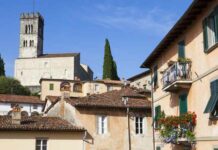
Pitigliano is an impressive medieval town in the Maremma of Tuscany, perched high on a tuff ridge. Etruscan tombs dot the cliff and the valley. Pitigliano is also known as Piccola Gerusalemme or Little Jerusalem.
Piccola Gerusalemme – Little Jerusalem
The Jewish quarter of Pitigliano was colonized by Jews in the 16th century when the city became a haven for Jews fleeing the closed ghettos of cities such as Siena and Florence. Even when the Jewish Quarter closed in 1622, relations between Jews and non-Jews continued, and it was known as the liveliest Jewish ghetto in Italy. When the Jews were emancipated in the mid-19th century, the population of the ghetto was roughly 500, representing a third of Pitigliano’s population. However, many of them left for the cities, and by World War II none remained.
The parts of the old Jewish quarter open to visitors include a small museum, the restored 1598 synagogue, ritual baths, dye jobs, the kosher butchery area, and bread ovens.
What to see in Pitigliano
The tourist information office is located in Piazza Garibaldi, just inside the main gate of the city. Ask about tours of the caves and tunnels below the city. In addition to the Jewish quarter (see above), Pitigliano is a good medieval city for a stroll. Here are some of the best things to see:
- Palazzo Orsini is a 14th century fortress near the entrance to the city. It is now a museum that houses works of art, Etruscan finds, and a medieval torture chamber. The 15th century walls that surround the medieval city are part of the Orsini fortress.
- A 16th century aqueduct runs along the side of the city and through Via Cavour.
- Chiesa di San Rocco is the oldest church in the city, dating back to the 12th century. During the recent reconstruction, an ancient tomb was discovered.
- The Cathedral of Saints Peter and Paul was built during the Middle Ages and remodeled in the 16th century in a Baroque style. Several good works of art are inside.
- The underground tunnels and caves carved out of the tuff below the city have been in use since Etruscan times, when the cliff was dotted with tombs. This underground area is sometimes open to the public on walking tours. Ask at the tourist office. There is also a Christian cave chapel dating from around 400 AD that is said to be the oldest in Italy.
- Piazza Becherini is the best place to visit the views of the valleys that surround the city.
Etruscan tombs and Maremma villages
- Etruscan sacred pathways and tombs dot the valleys of the Maremma, with at least ten in the Pitigliano Valley. The sacred paths, called Vie Cave , are narrow passageways carved through the tuff rock of the valley below Pitigliano. They connect to neighboring cities, once also Etruscan fortresses. They are fascinating to explore, and some have Etruscan and Roman markings along the tall vertical sides and are generally near a necropolis. Pick up a map of Via’s cave from the tourist office.
- Sorano, Sovana and Saturnia are the other three cities with Etruscan and medieval roots in the area. Sorano has two castles, Sovana has a well-preserved medieval center, and Saturnia is one of the oldest cities in Italy.
- Wine is produced in the Maremma and you will see vineyards as you drive through the countryside. The area around Pitigliano produces a good white wine called Bianco di Pitigliano and Kosher wine is still produced here as well.
- Monte Argentario is a coastal gem in the Maremma, 60 km from Pitigliano. It was once an island, but is now connected to the mainland by sandbars and lagoons. From here you can visit the Tuscan archipelago. Monte Argentario Travel Guide
Pitigliano Location and Transportation
Pitigliano is located in the Maremma region of southern Tuscany, a part of Tuscany that receives far fewer tourists than the central towns in the Tuscan hills. It is between Rome (140 km) and Florence (175 km), about 48 km southeast of Grosseto (see the Tuscany map for the location of Grosseto) and 25 km west of Lake Bolsena in the northern Lazio region.
There is no train station in the city, but buses serve Pitigliano from other Tuscan cities and towns, including Siena, Florence, and Grosseto (served by train). The town itself is small enough to walk easily. A car is recommended to tour the countryside, Etruscan sites, hot springs, and other small towns in the Maremma.
Where to stay and eat in Pitigliano
- Casa degli Archi (the House of Arches) comprises several charming little apartments in the old town.
- The cozy guesthouse Locanda Il Tufo Rosa is right next to the old town gate and offers modest rooms.
- Albergo Guastini is a 3-star hotel in the center with 27 rooms, many of them with views.
- The Hotel Valle Orientina is a 3-star hotel in the countryside, about 3 km from the city, with a spa, thermal pool and restaurant.
A good place to eat is Hostaria del Ceccottino in the city center. They serve Tuscan specialties and Maremma wines.
Article updated by Elizabeth Heath