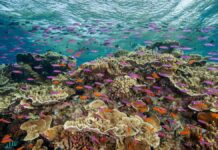
The Great Barrier Reef is a unique natural wonder. The government in Canberra is enraged that Unesco is now threatening to classify the ecosystem as a world heritage site.
Canberra – Australia’s government is strongly opposed to a recommendation by Unesco to put the Great Barrier Reef on the list of endangered world natural heritage sites because of environmental damage.
Environment Minister Sussan Ley criticized the UN organization in the draft proposal of the “outstanding and science-based strategies” of their country for the protection of the world-famous coral reef. The government was taken by surprise by the report.
In the Unesco draft cited by the government in Canberra, the World Heritage Committee urges Australia to take measures against climate change – also with a view to the quality of the water around the reef, which has been a World Heritage Site since 1981. The long-term prospects for the natural wonder have changed from “bad” to “very bad”. The repeated coral bleaching was also described as worrying. The World Heritage Committee intends to discuss the recommendation itself at an online conference in China in July.
The Great Barrier Reef off the east coast of Australia is the largest reef in the world and extends over an area of more than 344,000 square kilometers – making it larger than Italy. As one of the largest tourist attractions, it is also an important economic factor: experts estimate the value of the reef for tourism at around 20 billion euros. If it were listed as endangered, it could also affect thousands of jobs in the country, so the fear.
According to the environmental protection organization WWF, Unesco has sent the strongest possible message with the proposal so that Australia does more against climate change and for water quality. “The prospect of losing our reef’s World Heritage status will come as a big shock to many Australians,” said Richard Leck of WWF Australia. The recommendation is a clear warning to the Australian government to urgently improve the protection of the reef. As a leading producer of fossil fuels and because of the enormous emissions of climate-damaging carbon dioxide, Australia is already heavily criticized by nature conservationists.
The reef is particularly endangered by the climate crisis: the United Nations had already warned in the past that 90 percent of all corals in the world could die if global temperatures rise by 1.5 degrees. In December 2020, the International Union for Conservation of Nature (IUCN) sounded the alarm: The scientists classified the Great Barrier Reef in the highest category of “critical” in terms of its prospects for survival. The warming and acidification of the sea lead to the death of the corals, it was said.
Scientists had also found that coral bleaching on the Great Barrier Reef in the past year was heavier and greater than others in the past. The fading of the colorful hard corals is referred to as bleaching: When the water temperature is too high, the cnidarians repel the algae that provide the color, with which they otherwise live in a community for mutual benefit.
“I agree that global climate change is the greatest threat to the world’s reefs. But we believe it is wrong to single out the world’s best-managed reef for a list of endangered sites, ”lamented Environment Minister Ley.
She and Australia’s Foreign Minister Marise Payne had phoned Unesco Director General Audrey Azoulay to express their displeasure with the UN organization’s actions. She was stunned by the U-turn by Unesco, which had promised not to make such a recommendation before the conference in July, added Ley.
In the past few years Unesco had repeatedly threatened to put the reef on the list of endangered world heritage. In July 2017, Australia announced that the reef would not be on this list for the time being. The government’s action plan to protect the reef had convinced the responsible Unesco committee, it said at the time. Among other things, Canberra had announced that it would invest the equivalent of around 1.3 billion euros to improve water quality, for example. dpa