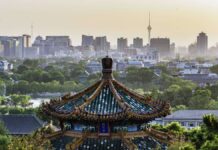
Xi’an is currently the capital of Shaanxi Province in central China, but in ancient times, it was the cultural and political capital of all of China for hundreds of years. It was during the Tang Dynasty that Chang’an City (now Xi’an) was a gathering place for merchants, musicians, craftsmen, philosophers, and more in the Tang court. They came along the Silk Road that ended in Chang’an.
First settlements in the region
Fertile and arable, the land in southern Shaanxi province has been settled for thousands of years. The first inhabitants lived 7,000 years ago in the late Neolithic times and established the area near Wei He , a branch of the Yellow River, in present-day Xi’an. A matriarchal agricultural society, the Banpo village settlement has been unearthed and can be visited today on a tour of Xi’an.
Zhou dynasty
The western Zhou dynasty (1027-771 BC) ruled China from Xianyang (then called Hao), just outside present-day Xi’an. After the Zhous moved their capital to Luoyang in Henan Province, Xianyang remained a large and influential city.
Qin Dynasty and the Terracotta Warriors
From 221-206 BC, Qin Shi Huang Di unified China into a centralized feudal state. He used Xianyang, near Xi’an, as his base and the city became the capital of his empire. To protect his newly established state, Qin decided that a large defense barricade was required and began work on what is now the Great Wall.
Even though his empire didn’t see two decades, Qin is credited with founding the imperial system that saw China for the next 2,000 years. Qin bequeathed China another tangible treasure: the Terracotta Army. An estimated 700,000 men worked on the tomb that took 38 years to build. Qin died in 210 BC. C.
Eastern Han and Han Dynasties and Chang’an
The Han (206BC-220AD) who conquered Qin, built their new capital at Chang’an, just north of present-day Xi’an. The city prospered and under Emperor Han Wudi, who sent an envoy Zhang Qian west to seek an alliance against the enemy Han, he inadvertently opened the Silk Road.
Tang Dynasty – China’s Golden Age
After Hans, wars ravaged the country until the Sui dynasty (581-618) was established. Emperor Sui began to revive Chang’an, but it was the Tangs (618-907) who pushed back his capital and established peace throughout China. The Silk Road trade flourished and Chang’an became a city of world importance. Scholars, students, merchants, and merchants from around the world visited Chang’an, making it a cosmopolitan metropolis of its time.
After the Tang dynasty fell in 907, Chang’an fell into decline. It remained a regional capital.
Xi’an hoy
Xi’an is now a place of industry and commerce. The provincial capital of Shaanxi, which is rich in natural resources such as coal and oil, Xi’an produces much of China’s energy. Because of this, the city is heavily polluted, which can certainly affect your enjoyment of the city while visiting it. However, there is a lot to see and do in Xi’an, so it is definitely worth considering.
The biggest tourist destination is the amazing Tomb of Emperor Qin and the Terracotta Warriors Army. This site is about an hour (depending on traffic) outside of downtown Xi’an and takes a few hours to visit.
Xi’an has some cool things to do. It is one of the few Chinese cities that still retains its ancient wall. Visitors can buy a ticket to the top and walk through the old city. There are even bikes for rent so you can circumnavigate the city from the wall by bike. Inside the walled city, there is an old Muslim quarter and here, strolling the streets at night, trying the street food, is a Xi’an adventure like any other.