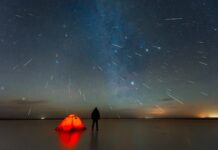
The Milky Way, that bright path of stars that has dominated the night sky since time immemorial, is but a blurry memory for a third of today’s population due to light pollution. According to a team of scientists from Italy, the USA, Germany and Israel who have drawn up a detailed global map of this problem, 80% of humanity is seriously affected by light pollution.
“There are entire generations of people in the United States who have never seen the Milky Way,” says Chris Elvidge, a co-author of the study and a scientist with the NOAA administration’s National Centers for Environmental Information. Light pollution is one of the most widespread forms of environmental impact. In more developed countries, the presence of artificial lights everywhere creates a kind of haze that prevents the stars and constellations from being seen in the night sky.
“We hope that the atlas will make people aware of the seriousness of the light pollution problem,” says Fabio Falchi, lead author of the study and researcher at the Institute of Light Pollution Science and Technology in Italy. Scientists have made the map with data from high-resolution satellites such as NASA’s Suomi National Polar-orbiting Partnership system and other detailed measurements of sky brightness. The results offer the most accurate analysis to date of the impact of artificial lights on a global scale on our planet.
According to the study, Singapore, Italy and South Korea are among the countries where light pollution is most intense, while Canada and Australia , which are very large and sparsely populated nations, still have the darkest skies. In Western Europe, only in some regions, mainly in areas of Scotland, Sweden and Norway , can the stars be well observed. Spain also suspends light pollution, except in areas such as the Canary Islands, Sierra Morena or Gredos .
On the other side of the Atlantic, and despite the vast open spaces of the American West, almost half of the US states are exposed to light pollution at night. National parks like Yellowstone and the desert of the Southwest are almost the last refuge from the dark. Light pollution not only deprives humans of the opportunity to admire the night sky; it can also confuse wildlife: insects, birds and sea turtles suffer particularly from it, sometimes with fatal consequences. The problem can be controlled by placing screens on the bulbs to limit their brightness in the environment, reducing the hours of artificial lighting, using light bulbs of less impact or simply turning off the light when it is not necessary.