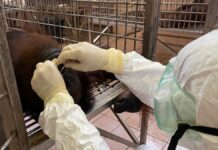
The Semenggoh Wildlife Rehabilitation Center is located just 12 miles south of Kuching, in Borneo’s 1,613-acre Semenggoh Nature Reserve. Since 1975, the center has accepted orphaned, injured or rescued animals from captivity and reintroduced them into the wild.
The Semenggoh Wildlife Rehabilitation Center is not a zoo; Unless quarantined, the animals are not kept in cages and are free to roam the thick green canopy of the forest.
Rather than just attracting tourists, the main goal of the wildlife center is to rehabilitate the animals and bring them back to the wild if possible.
Endangered orangutans are the main reason people visit the Semenggoh Wildlife Center, although rangers work with other species, such as crocodiles and hornbills. The center offers an increasingly rare opportunity to see orangutans in a natural habitat; Many orangutans at the refuge are considered semi-wild and rarely return to the rehab center.
About orangutans
Orangutan means “forest people” in the local language; the name fits well given the primates’ superior intelligence and human personality. In 1996, a team of researchers witnessed a group of orangutans making and sharing sophisticated tools to extract seeds from the fruit.
Orangutans are native only to Borneo and Sumatra and are considered extremely endangered. Of the 61,000 estimated orangutans that exist in the wild, just over 54,000 live on the island of Borneo. Female orangutans typically produce only one young every seven to eight years, hence the population decline.
Seduku, the “grandmother” of the Semenggoh Wildlife Rehabilitation Center, was born in 1971 and has given birth to several young. Ritchie, the alpha male at the shelter, weighs over 300 pounds and was rescued by a reporter. Most of the orangutans in the center are named, and rangers can easily identify them with a glance.
While the Semenggoh Wildlife Center is doing its best to preserve orangutans in Sarawak state, the Sepilok Orangutan Rehabilitation Center is doing its part in Sabah.
Visiting the Semenggoh Wildlife Rehabilitation Center
When you first arrive at the Semenggoh Wildlife Rehabilitation Center, you need to purchase a ticket from the window near the entrance. From the entrance, it is necessary to walk almost a mile on the paved road to the orangutan area.
If it’s open and the weather permits, there are plenty of nice gardens, nature walks, and an arboretum along the main path through the wildlife center.
To protect both orangutans and tourists, the center no longer allows people to walk through the refuge on their own. Groups of up to five people are accompanied by a ranger into the forest for a fee of $ 13 per group.
- Hours: The Semenggoh Wildlife Rehabilitation Center is open seven days a week, including holidays from 8 a.m. to 12:30 p.m. and 2 to 4 p.m. Feeding hours are from 9 a.m. to 3 p.m.
- Cost: Adults – $ 1; children – 50 cents. The cost of admission is only for the food area. A ranger will lead groups of up to five people into the forest to search for orangutans for $ 13 per group.
- Contact: Phone +60 082-618423
The center has cold water and drinks at prices cheaper than those found in stores around Kuching; Food is not available.
Feeding times
Orangutans are extremely lonely and usually the only chance for decent photos is during organized feeding times. Even then, there are no guarantees, and possibly only one or two orangutans can show up to pick up the remaining fruit on the platforms.
- Morning: between 9 a.m. and 10 a.m.
- Afternoon: between 3 pm and 3:30 pm
Rules and safety when seeing orangutans
- Be quiet.
- Turn off your camera flash!
- Never get closer than 20 feet to an orangutan, they have been known to injure humans.
- Do not stay directly below the orangutans if they are above.
- Absolutely no food, water bottles or smoking are allowed around the orangutans.
Get to the Semenggoh Wildlife Center
Getting to the wildlife center can be tricky, but luckily, there are several options. Buses leave from the Sarawak Transportation Company (STC) office at the Jalan Mosque, not far from India Street, on the west side of the Kuching coast. Bus times change frequently and sometimes the buses don’t run at all.
A one-way ticket to Batu 12, the closest stop to the wildlife center, should cost around 70 cents. Bus numbers 6, 6A, 6B and 6C stop near the Semenggoh Wildlife Center; always let your driver know where you are going when boarding. The bus ride takes between 30 and 45 minutes.
Alternatively, you can take a taxi to the wildlife center (around $ 20) or team up with other travelers to share the costs of a minivan (around $ 4 per person).
Going back to Kuching
The last city bus returning to Kuching passes through the wildlife center between 3:30 pm and 4 pm You must stop the bus on the main road. If you miss the last bus, it is possible to negotiate a ride home with the minivans already waiting for passengers in the parking area.