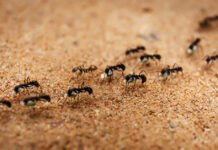
Few organisms except humans have colonized the planet as effectively as ants . Now, photographers Heidi and Hans-Jürgen Koch show us the spectacular secret life of these social insects.
Heidi and Hans-Jürgen Koch have been capturing the thousand and one facets of fauna, domestic or wild, for over two decades. And they are good. Very good. In fact, among other awards, his work has deserved the recognition ofWorld Press Photo, which organizes the contestPhotographymost prestigious in the world. It is clear that this German couple makes a good team. Both are in charge of practically 100% of the production of their works, from the search for copies to the editing of the images, a task that in their last work stars theants.
Although seen closely these insects have a certain alien air, the truth is that millions of years before the firsthomo sapienscolonized Europe, they already knew how to organize themselves in complex and structured societies.
They have spread throughout the planet, except Antarctica
The more than 14,000 known species of ants are believed to have evolved from an ancestor that lived in the mid-Cretaceous, about 120 million years ago. Since then, they have adapted and today, with the exception of Antarctica and some islands, they occupy all the land areas of the planet. The key could be found in their ability to coordinate and found new colonies, which can house from a few dozen to millions of individuals. One of the largest that has been reported covers 6,000 km!, From Portugal to northern Italy.
In general, these superstructures are organized around a queen, larger and longer-lived – she can live 30 years – than the workers. They take care of practically everything in the anthill, from taking care of the pupae to obtaining food, something for which they have developed very sophisticated strategies. In fact, according to entomologists Ted Schultz and Sean Brady of the Smithsonian Museum of Natural History, in the United States, several species learned to grow mushrooms 50 million years ago and today they have improved the technique to the point of having their own gardens that explode as expert farmers.
Abraham Alonso

Close up
Red wood ant portraitPolyctena ant, which plays an important role as a predator in the control of forest parasites.
© H.&H.-J. Koch/animal-affairs.com
A treasure trove of proteins
IsPolycten anta, very common in European forests, has found the carcass of a dragonfly. As a report of the discovery, an army of comrades will go to the place to cut it up and transfer it to the anthill.
© H.&H.-J. Koch/animal-affairs.com
Thousands different
So far, entomologists have identified more than 14,000 species of ants.
© H.&H.-J. Koch/animal-affairs.com
The workers’ revolution
The worker ants are usually infertile females, but there are cases, as in the Harpegnathos genus, in which they can also lay eggs as if they were queens – above, two compete for this right – and even found new colonies. Very
© H.&H.-J. Koch/animal-affairs.com
Find the differences
The extraordinary organization that these carpenter ants boast -Camponotus fellah- has attracted the attention of a team of researchers from the University of Lausanne, in Switzerland, which has tagged its members to study the role of each one.
© H.&H.-J. Koch/animal-affairs.com

Pause for a drink
A drop of water serves as an improvised spring for some forest ants, whose length is around 5 mm.
© H.&H.-J. Koch/animal-affairs.com
A very tasty little house
In 2003, NASA developed a special translucent gel that served as both habitat and food for a group of ants. Thus, astronauts could easily study their behavior in a microgravity environment.
© H.&H.-J. Koch/animal-affairs.com
Competition for water
These fire ants drink from a droplet of water that hangs from a leaf. Like humans, these Hymenoptera need the vital fluid to survive.
© H.&H.-J. Koch/animal-affairs.com
The pharmacy in tow
Some ant species collect resin from trees. This substance strengthens their immune system and allows them to better resist bacteria.
© H.&H.-J. Koch/animal-affairs.com
You don’t play with cocoons
The workers move the pupae to the areas of the nest with the most favorable conditions -top-. In these capsules, the insect develops the physiognomy that it will present in adulthood – one of the eyes can be seen in the photo in the center. Newly hatched ants take a few days to harden and acquire the final coloration.
© H.&H.-J. Koch/animal-affairs.com
Specialized work
Depending on the needs of the colony, its members fulfill specific functions. This one guards the entrance to a nest.
© H.&H.-J. Koch/animal-affairs.com
Super ant
Close-up of the Asian ant Harpegnathos venator, inhabitant of Southeast Asia, India and Malaysia. It has wide jaws and excellent vision. He is able to jump up to 10 centimeters and can walk on his back.
© H.&H.-J. Koch/animal-affairs.com
The house always clean
Photographers Heidi and Hans-Jürgen Koch show us scenes from the spectacular secret life of these social insects, like this one of a red ant pulling out a dead spider that had fallen into its nest.
© H.&H.-J. Koch/animal-affairs.com