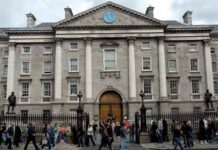
Trinity College is the oldest university in Ireland that is still in operation today. The historic college is a must-see part of the Dublin landscape and is located right in the center of the city. Its sacred halls have educated some of Ireland’s most famous figures during more than 400 years of distinguished operation.
From its history to its sights, this is your guide to visiting Trinity College in Dublin.
Story
Trinity College has been a part of higher education in Ireland for centuries, but technically it is not the oldest university in Ireland. Dublin Medieval College was established in 1320, but was closed due to lack of funds and changing political pressures during the Protestant Reformation.
Founded in 1592, Trinity College has its own ties to the Reformation. The university was established on the site of a former monastery by the royal charter of Queen Elizabeth to prevent the Irish from being “infected with popery and other noxious qualities” at universities in Italy, Spain, and France.
Beginning in 1637, Catholics were banned from attending Trinity, a ban that remained in effect until the Catholic Relief Act of 1793. However, bans can go both ways and, although technically Catholic students were allowed enter, they were never allowed to achieve the same. recognition as scholars. Because of these rules, the Catholic Church retaliated and prohibited its faithful from enrolling in Trinity until 1970.
These days Trinity College is the most prestigious university in Ireland and has a student body of all genders and religions.
Famous graduates
Many famous scholars have walked the halls of Trinity in the 400 years since the university first opened. Some of the most notable graduates are Nobel Prize winners Ernest Walton (physics) and Samuel Beckett (literature). In addition to Beckett, other world-renowned authors who studied at Trinity include Jonathan Swift, Oscar Wilde, and Bram Stoker.
Trinity has also educated famous Irish politicians, including Ireland’s first president, Douglas Hyde, as well as Mary Robinson and Mary McAleese, who also served as presidents of Ireland. And although Trinity was known for its Anglican leanings, some of the most important figures in the fight for Irish independence were also educated here. That includes Theobald Wolfe Tone, who graduated with a law degree in 1786 and later led an Irish rebellion; as did Robert Emmet, who studied here but later led the revolt of 1803.
To do
Trinity College offers official campus tours to learn about history, experience modern Trinners life (slang for Trinity College students), tour the famous library, and see the university’s most famous attractions – Book of Kells.
The Trinity College Library is a depository library, which means it has a copy of every book printed in Ireland. You are also entitled to a copy of any book printed in the UK, all free of charge. Over the years, the library has amassed a collection of more than 5 million volumes.
However, the most famous of all is undoubtedly the invaluable Book of Kells. The Book of Kells is one of the most important illuminated manuscripts in the world. The book was created in the 9th century by Irish monks who wrote elaborate scroll texts and created detailed decorations on each page of the four gospels included in the calfskin book. Only two pages of each of the two volumes are shown at any one time, but it is an essential stop on any Dublin itinerary. The book has been on display at Trinity’s Old Library since 1661.
While most people have to take a tour, or buy a ticket, to view the Book of Kells, one of the many benefits of studying at Trinity is that students can visit the famous manuscript as much as they want, free of charge.
However, there is a silver lining to being a visitor rather than a student. There is an old superstition that any student who walks under the bell tower while the bell rings will fail their exams. That means the beautiful steeple is generally free of crowds, except on graduation day when graduates (who have now passed all of their tests) march under it.
If you want to explore the campus on your own, the main entrance is the most impressive and opens onto Front Square. However, you can also access the campus from Nassau Street and through the Lincoln Place entrance.
What else to do nearby
Trinity College is truly in the heart of Dublin and there is so much to do nearby. First, head to the National Gallery to admire the extensive collection that includes works by Rembrandt and Diego Velázquez. After enjoying the art, stroll through Merrion Square, where you can see the most impressive examples of Georgian architecture in the city.
The award-winning Science Gallery is also nearby, or you can head to Grafton Street to experience Dublin’s liveliest shopping area. Otherwise, relax with a pint and some live Irish music at O’Donoghue’s, one of the best pubs in the Irish capital.