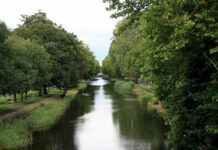
If you want to take a walk in Dublin, walking along the River Liffey is the easiest option. Dublin’s most logical walk simply follows the course of nature: a walk along the banks of the legendary Liffey, the river that divides the Irish capital in two, divides the Northside from the Southside. Although you won’t really pass many of Dublin’s top attractions, this walk is one of the unique experiences that Ireland’s capital city has to offer. You will simply follow the course of the River Liffey through the city, from the resurrected Dublin Docklands to Phoenix Park.
Starting in the Docklands
The most logical place to start this hike is in the Docklands, a run-down area that has undergone extensive renovations. Make your way to the Dublin Docklands Development Authority (DDDA) offices between the International Financial Services Center (IFSC) and the Jurys Hotel. Then climb onto the pedestrian bridge, officially the Sean O’Casey Bridge, and look around – to the east you can see the harbor and the new Samuel Beckett bridge, shaped like a harp. Near the tall ship “Jeanny Johnston” it is usually docked.
South of the bridge is a monument to the merchant seamen killed during the “Emergency” from 1939 to 1945. Nearby you will also find “The Line Judge”, a realistic bronze worker.
Turn west and you will come to a modern road bridge – the Matt Talbot Memorial Bridge with an impressive statue of the revered Dublin mystic near its southern end. From here you can enjoy the panorama of the Customs House on your left and the modern IFSC on the other side of the Liffey. Cross the bridge and catch a glimpse of the eerie Famine Group just to the right, continue west past Customs. And don’t forget to look at the modern structure that houses the Ulster Bank – photographers will love the way Customs is reflected on its facade.
Walk under Dublin’s biggest eyesore, the dark railway bridge, pass the Butt Bridge and continue upstream along the river. The tall town on your right is Liberty Hall, Dublin’s tallest building and union headquarters. A statue of the Irish-American socialist James Connolly stands in front of the Liberty Hall below the elevated railway. And in the buildings that line the Liffey, you’ll notice remnants of Dublin’s maritime past.
The heart of Dublin city
You are now coming towards O’Connell Bridge with O’Connell Street on your right. This is the center of Dublin. And a rather curious bridge, being actually wider than it is long. Look around and then continue on Bachelor’s Walk, heading for the Ha’penny Bridge.
Well, officially this is the ‘Liffey Bridge’, formally known as ‘Wellington Bridge’, but a half-cent pedestrian toll has since been introduced with the nickname Ha’penny Bridge attached. Cross the Liffey (it’s free these days), the little lane right in front of the Ha’penny Bridge would take you to the Temple Bar District. However, turn right, walk to the new Millennium Bridge, and cross the river again. Again, stop in the middle, take in the view, then continue upriver.
Viking Dublin
Just before reaching the Grattan Bridge, look across the Liffey at the embankment. You should see a grated tunnel entrance there, this actually at the mouth of the Poddle River, which formed a ‘dark pool’ (or Irish dubh linn ) nearby. Here the Vikings established a settlement. Then cross the Grattan Bridge, the entrance to Dublin Castle is visible at the end of Parliament Street. Also visible are the Sunlight Chambers next to the bridge, a magnificent corner building with splendid works of art praising cleanliness and soap!
Following the Liffey upstream, you will notice a strange set of park benches on the left, recreating the image of a sinking Viking ship. Later, the prow of a Viking ship was the inspiration for the monument outside the (modern) council offices. And walking, you will discover bronze entrances in the pavement – copies of Viking artifacts excavated here a few years ago. You are in the heart of Viking Dublin!
When you get to O’Donovan Rossa Bridge, you should enjoy the views from here – to the south, the Christ Church Cathedral is crowning the ascent. And to the north, the Four Courts are lining the Liffey. Stay on the south bank of the river and walk, the views of the court buildings are better from here.
Dublin’s Favorite Drinks
The next bridge is the Father Matthew Bridge, a fitting monument to the founder of the temperance movement due to its location.
You will notice a tall chimney-shaped structure on the north side, this is the old chimney of the Jameson Distillery. And the Guinness Brewery is not far away, in fact you will pass it as you continue on Liffey and past the Mellowes Bridge, Blackhall Place Bridge and Rory O’More Bridge until you finally reach the Frank Sherwin Bridge and the nearby Sean Heuston Bridge. You can also get a good malt smell if the wind is right.
Journey’s End – Back to Dublin City
Take a look at the magnificent facade of Heuston Station, then cross over to the North Docks and walk downstream, passing the Civil Defense Depot on your left. The park next door is the “Croppy Acre”, a mass grave for those killed in the 1798 uprising. Turn left after passing this and walk to Collins Barracks, the National Museum of Ireland.
Even if you are not culturally inclined, the cafeteria will be a pleasant sight. And after you have renewed your energy, you can simply take a LUAS tram back to the city center.
However, if you feel very energetic again… a short walk west will take you to Phoenix Park, Dublin Zoo or the rarely visited War Memorial at Island Gardens.