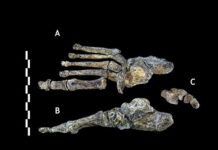
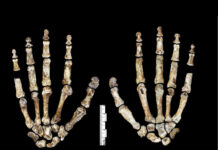
To conduct research, just published by the journal Folia Primatological, scientists conducted t omografías you computerized high – resolution the capitatum bone (the bone in the center of the wrist) current primates with different forms of locomotion and posture, and in fossil hominids from Kenya: Austrolopithecus anamensis from Kanapoi (4.2 Ma) and Austrolopithecus afarensis from South Turkwell (3.5 Ma).
With the results of the tomographies, virtual models were obtained that allowed biomechanical tests to be carried out. This could conclude that l as arboreal species behaviors constantly redirect the load or force to the ulnar side of the central bone, while terrestrial species and bipedal this force directed toward the thumb.
Thus, it has been shown that Austrolopithecus anamensis followed arboreal behaviors, while Australopithecus afarensis did not. The transformation, therefore, occurred between 4.2 and 3.5 million years ago, as the study points out.