We are living in the golden age of music video games, which have become one of the most profitable products in the industry since plastic guitars made an appearance. The sale of the single songs in download and the arrival of the rest of the instruments, contributed to catapult the phenomenon to the top.
As a logical consequence of this rise in popularity, musical repertoires have progressively approached the mainstream territory (the equivalent of the casual term in video games), so that hard rock and metal have been giving way to more pop sounds. Examples like the selection of songs from ‘Guitar Hero: World Tour’ or the imminent ‘The Beatles: Rock Band’ give a good example of what I mean.
But someone had to say enough is enough, and decide to recover the true essence of the “little guitar” games. Someone had to give us back the impossible guitar solos, the drums at a thousand per hour and the neckbreaker hits forged in the flames of hell. Someone had to give us the rod back, and no one better at that than Metallica .
The Four Horsemen
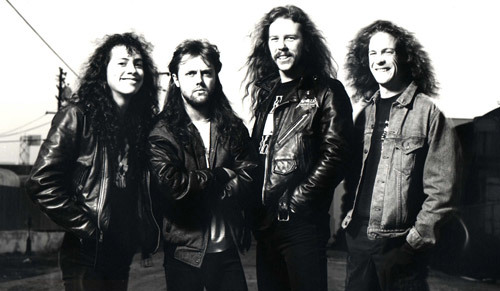
The history of ‘Guitar Hero: Metallica’ begins to take shape in the early 80s, with the effervescence of punk practically exhausted, and the New Wave of British Heavy Metal in full swing thanks to bands like Iron Maiden or Judas Priest. In the midst of all this, a certain Lars Ulrich would put an ad in a Californian newspaper, looking for members to form a band, to which James Hetfield would respond without knowing that this was the beginning of a legend.
After signing the temperamental Dave Mustaine for lead guitar and the unrivaled Cliff Burton for bass (who replaced Ron McGovney, who passed by without pain or glory), Metallica would begin their journey by writing their own rules: based on robust British heavy metal. , they added the fierce speed of punk, resulting in an entirely new genre, thrash metal.
The internal conflicts would cause Mustaine to leave the band to form his own thrash group, Megadeth, and in his place would enter Kirk Hammett . In 1983 their explosive debut Kill ‘Em All would go on sale, followed by the band’s two great masterpieces, Ride the Lightning and Master of Puppets. After that, the tragedy would shake the band with the accidental death of Burton, who by then had already become a legend of the four strings.
With Jason Newsted as the new bassist, it would go on sale in 1988 … And Justice for All, where the early thrash would begin to give way to more progressive sounds. This change of record would finish formalizing with Metallica, also known as The Black Album, the last great album of the first stage of the band.
After him, would come the dark years, those of mediocre albums and conflicts that brought the quartet to the brink of rupture. Load and ReLoad still had their remarkable songs, but St. Anger, after which Roberto Trujillo would take up the bass knobs, is simply forgettable. Despite this, luckily for us all was not lost.
With the arrival last year of Death Magnetic, their last LP to date, the band was able to recover the roots of their thrash sound and bring them up to date, forming one of the most notable metal albums of the past year. And in this second youth of the band, ‘Guitar Hero: Metallica’ comes to us.
The Memory Remains
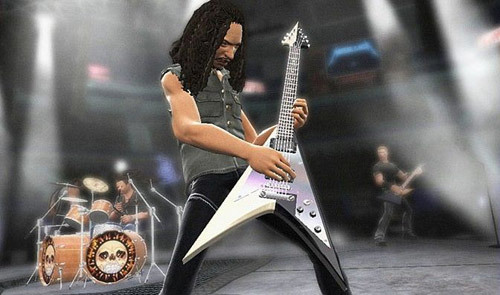
From a purely playable point of view, this title is the same one that was put on sale a few months ago under the name ‘Guitar Hero: World Tour’, with a few tweaks here or there. Activision has never tried to fool anyone with it: it is not the next step forward in the franchise (that will come with ‘Guitar Hero 5’), but a modification thought by and for the followers of the Californian quartet.
The main mode varies slightly, and instead of presenting a multitude of concerts of a few songs to be completed, we find scenarios with dozens of songs, which are opened in a block when a certain number of stars is achieved. The main change is that we advance song to song, rather than concert to concert.
Naturally, it preserves all the new features introduced in the last title in the saga: cooperative mode for up to four players with all the luggage, a recording studio, a quite complete rocker editor and other possibilities that give rise to many hours of gameplay.
Before leaving the purely playable level, it should be noted that the difficulty increases slightly, a logical consequence of a much more demanding repertoire of songs. As an added bonus for the more purists, the Expert + difficulty mode lets you connect two pedals to the drums to play the double kick, and emulate Ulrich even more closely.
Hit the Lights
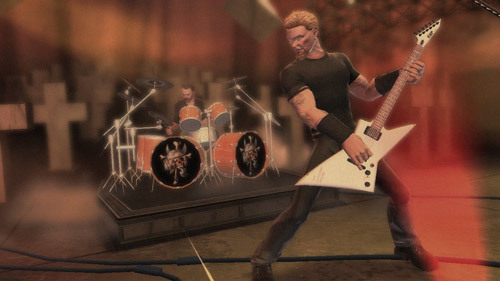
But as you may have already guessed, the game’s greatest appeal is in everything it offers to the band’s fans , and that’s where it shines with all the laws. From the first menu, everything that happens before our eyes is in accordance with the group’s iconography, with a multitude of winks and details that are appreciated.
How could it be otherwise, the video clips, the photographs and the recordings of all kinds become the juiciest extras, although what I liked the most are the Metallifacts, details and curious anecdotes about each of the songs included in the game, which are related to us while we see how the cybernetic group interprets them.
The lead band’s repertoire of chosen songs is outstanding, ranging from the calm rhythms of ‘Nothing Else Matters’ to the onslaught of notes of ‘Fight Fire with Fire’. On a personal basis, I miss some songs like ‘Of Wolf and Man’ or ‘Damage, Inc.’, but in any case it more than delivers.
As for guest artists, things are already somewhat more irregular, and although songs like ‘Ace of Spades’ by Motörhead or ‘Blood and Thunder’ by Mastodon always go well, there are others that become more bland. For example, I can think of dozens of Alice in Chains songs more appropriate than ‘No Excuses’ for this game.
…And Justice for All
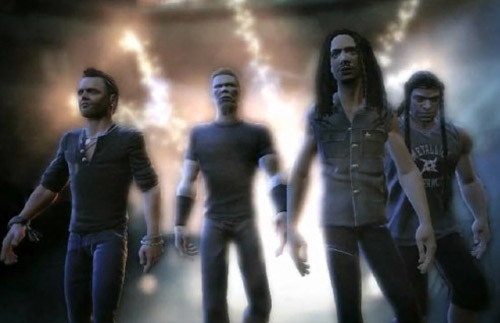
In short, for ‘Guitar Hero: Metallica’ to be worthy of entering your game library, you have to meet two conditions: first, that you like the ‘Guitar Hero’ saga; and second, that you are a follower of Metallica. If one of those two legs limps, I do not recommend investing your money in this title, but as long as you comply with both, the hours of enjoyment are more than assured for you.
A very solid repertoire of songs, a careful setting that lavishes on the details towards the fans and all the virtues that the ‘Guitar Hero’ franchise brings from home are its great workhorses. But this last point is at the same time its great weak point, since the lack of truly noteworthy playable news may destroy the aspirations of more than one.
In any case, the target audience for Activision’s title is pretty clear beforehand, so it will be difficult for anyone to be disappointed in it. A product designed for those of us who have been yearning for a game that unleashes the metal that flows through our veins for so long.
Datasheet: Guitar Hero: Metallica
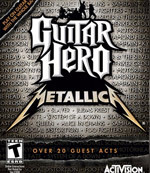
- Platforms : PS3, PS2, Wii, XBox 360 (Analyzed version)
- Distributor : Activision
- Studio : Neversoft (PS3, XBox 360), Budcat Creations (Wii, PS2)
- Launch : Now available
- Price : 69.95 euros (game only), 109.90 euros (game and guitar)
Video | YouTube
Official site | Guitar Hero: Metallica