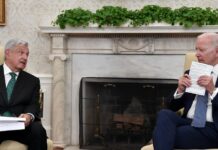
President Andrés Manuel López Obrador is too confident. Its response has been basically the same since the United States announced that it would initiate a consultation on the changes to the rules of the energy market: Mexico has a chapter within the Treaty between Mexico, the United States and Canada (T-MEC) that shields it from make the modifications undertaken by his government in order to achieve his objectives , he has said in his morning conferences. But the argument could quickly fall apart, analysts say, and using it as a defense within negotiating strategy would almost immediately put the country at a disadvantage.
Chapter 8 , which is barely five paragraphs long, was negotiated at the last minute at the request of López Obrador after he won the presidential election. It was the last part of the agreement to be closed and in it some words were placed on which the president now bases his main defense: “Mexico reserves its sovereign right to reform its Constitution and its internal legislation,” says the text. In the chapter, perhaps the shortest in the treaty, it is also stated that Mexico “has direct control and inalienable ownership of all hydrocarbons in the national subsoil.”
But the Mexican side is forgetting a detail, say the lawyers interviewed: the country can modify its constitution and its rules as long as it complies with its obligations under international law , some agreed to in the agreement signed in 2018. “Mexico has the right to change its rules as long as they are not in violation of international law, you can do it as long as you comply with your obligations signed in the treaty. There is a principle that says that no State can use its own right to expel itself from its international obligations”, explains Francisco Cano, a lawyer specializing in dispute resolution and international arbitration at the firm Baker & McKenzie.
In the letter sent by the United States a couple of weeks ago, the administration of Democrat Joe Biden accuses the Obradorista government of violating three chapters of the treaty : national treatment and access to markets; the investment chapter, and the chapter on state-owned companies and designated monopolies.
In all of them, basically, Mexico undertook to give fair and equitable treatment to investments regardless of their origin, carry out transparent processes and respect the rule of law. The jurists see an easy defense –if reaching the formation of a panel– of the US and Canadian parties: the Mexican government has been open in saying that all its changes have been aimed at favoring the state-owned Pemex and CFE. But for the Mexican side, to use Chapter 8 as the main argument, they predict a strong disadvantage.
David Enriquez, a lawyer specializing in energy law, explains the treaty like taking a photograph. As soon as it was signed, he says, all the investments and the opening of Mexico to foreign capital were ‘portrayed’. From then on, all changes made going forward would have to be made in compliance with the conditions prior to the negotiation of the agreement. “What the panel is going to say [in case of compliance] is: ‘this matter has nothing to do with chapter 8, the chapter does not restrict you from making changes to your constitution and legislation, but that cannot go against the investors from Canada and the United States. And since they can’t go against it, you’re breaking the treaty,’” he says over the phone.
The T-MEC includes the principle of non-retroactivity , which implies that all legal modifications made after its signing could not apply to investments made previously, nor could they close previously open markets, such as electricity generation.
The Mexican side has forgotten another detail, the lawyers say. In the chapter, Mexico emphasizes the ownership of the hydrocarbons in the territory, but none of the paragraphs refer to the electricity market, one of the main reasons for the dispute. The United States claims that, with the reform of the Electricity Industry Law (LIE), the Mexican administration favored the power plants of the state-owned CFE, by changing the order in which the generated energy is dispatched.
Mexico reserved exclusivity over nuclear power generation in the treaty. He should have done the same with the rest of the modalities, the sources explain, and include it in some reservation. “In the treaties, when you want something, specifically a subject, not to be covered, there is an express chapter to make those reservations or exclusions. Mexico did not do that and certainly the United States and Canada would not have accepted it”, explains Luis Felipe Aguilar, partner of the Aguilar & Loera firm.
The interviewed lawyers agree that Chapter 8 does not raise anything new within the agreement: the signatory nations always had the right to reform the constitution and its rules. And they find in adherence to the text only a political strategy. “If they had wanted to modify the rules in the energy market, as is being done now, the wording of the text would have to have been very different, nothing that was added protects Mexico from making the changes,” says a former official who has requested not be quoted.
Mexico, the United States and Canada will enter the consultation process in the coming weeks. The jurists interviewed predict very little probability that Mexico will give in to international demands or that the other two countries will renounce their claims.
But they already affirm that placing chapter 8 as the main defense argument would be a wrong strategy and an extremely weak argument. “In the least it saves us. One thing is that Mexico has direct control and inalienable ownership of all the hydrocarbons that are in the subsoil, nobody questions that, the issue is that you cannot make a partial interpretation of the treaty and consequently of the obligations and rights. So you cannot arbitrarily say what applies to you, at what time and if that can be your shield or your umbrella so that it gives you the opportunity to breach the other principles,” says Aguilar.
“The fact that Mexico intends to hide behind this declaration or this acknowledgment provided for in Chapter 8 is a totally flimsy argument. If that’s the defense, Mexico has no chance of prevailing.”