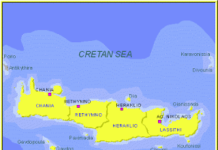
Crete is the largest island in Greece. While it has charming villages in abundance, Crete has something that no other Greek island can claim: a city. Also, Crete has five of them, all of which grace the north coast.
The multiple metropolises of Crete should not surprise us, even in very remote times, Crete was known as an island of cities, ninety of them, according to Homer. While these ancient sites were hardly “cities” in the most modern sense, they were centers of commerce, industry, government, and defense. Furthermore, the modern cities of Crete seem to have risen above the ancient ones, giving us the idea that the Minoans would have little trouble with modern urban planning. They picked good locations three or four thousand years ago, and we haven’t improved their choices much.
Heraklion – Capital of Crete
Once called Candia or Kandia, the city of Heracles or Hercules occupies the site of an ancient Minoan port. The site of the Minoan palace of Knossos is a short distance inland, alongside what was a navigable river in ancient times. Knossos itself is built on a Neolithic site that may be the first permanently inhabited site on Crete, making it, and Heraklion, among the oldest inhabited sites in existence today.
More about Heraklion:
- Heraklion Archaeological Museum
- Nikos Kazantzakis Airport – Heraklion
- Quick view of Heraklion
Chania – The city of the west
Chania, also called Hania, Xania, and similar variants are found in western Crete and is adjacent to the large city of Kissamos. Chania has been an important port throughout its history, and probably preserves a memory of Minoan maritime navigation: roads were not as crucial as waterways, so large regularly spaced ports were probably also a feature of the ancient Minoan life. Chania has a busy airport and is also adjacent to the American base in Souda Bay, attracting many American visitors.
Rethymno
Located between Chania and Heraklion, this port city is not as well known as its neighbors to the east and west. It has a charming historic district, and since it is less popular, prices are lower at hotels, restaurants, and even souvenir shops.
More about Rethymno
Sitia
Home to an excellent Archaeological Museum displaying the mysterious large ivory figure called Paleokastro Kouros, Sitia has a small port that provides access to some of the Dodecanese islands and beyond. A small airport is being considered for expansion, so Sitia could soon be a viable alternative to reach Heraklion.
Agios Nikolaos
The easternmost city of Crete, Agios Nikolaos, is close to the luxury resorts of Elounda and the ancient city of Lato, and is also a stop for some boats to the Dodecanese islands. It has an excellent Archaeological Museum, a deep inland bay that is said to be bottomless, and numerous restaurants and nightclubs.
Mallia or Malia
While Mallia does not qualify as a city, it is primarily a row of restaurants and bars, with some shops and little to no local industry other than serving drinks to tourists, it is also built on a site originally chosen by the Minoans, who erected the Well preserved palace of Mallia along the coast.
Mires and Tymbaki
Larger cities in southern Crete on the coastal edge of the Mesara Plain, these cities are agricultural centers with relatively few hotels or other accommodations. That is left to the smaller towns in the region, including the pleasant village of Kamilari, the seaside town of Kalamaki, and the famous ‘Hippie Town’ of Matala. If you are traveling by bus from Heraklion to visit the ancient Minoan palace of Phaistos, you will usually change buses in Mires. Mires is also spelled ‘Moires’, particularly on the signs marking the road from Heraklion, so if you’re driving, look for the alternate spelling.
It hosts a street market on Saturdays and has a couple of car dealerships on the outskirts of town. Both cities depend on local commerce rather than tourist shopping.
Other major cities on the south coast also cannot be called cities, but include Paleochora to the west, Chora Sfakia on the coast, and Ierapetra to the east. Chora Sfakia is the capital of the Sfakia region, but still, it maintains a seaside village feel and can be reached by both road and ferry. It is a stop for many tourists visiting the Samaria Gorge, as the ferry deposits thousands of them each day to board the buses back to the north coast of Crete after descending through the gorge.