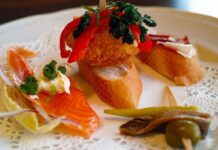
‘Pintxo’ is a ‘Basque’ version of the Spanish word ‘pincho’, which itself comes from the verb ‘pinchar’, which is ‘pierce’. Skewers are traditionally pierced with a cocktail stick to attach it to the piece of bread to which they were invariably attached. However, as Basque cuisine has evolved, food is now less likely to be pierced into a piece of bread than before.
Pintxos (or Pinchos) vs Tapas
The difference between a pincho and a tapa is complicated and largely depends on the context and location in Spain.
A significant minority of Spaniards who have not traveled much in their own country have the idea that a pincho is paid and a tapa is always free. This is simply not true.
The basic uses of ‘pincho’, ‘pintxo’ and ‘tapa’ are as follows:
- In the Basque Country, they serve you ‘pintxos’ . They are never spelled ‘pinchos’ and they are never called ‘tapas’. This is the case, regardless of whether a piece of bread is served ‘poked’ with a cocktail stick or not. Even if they serve you a plate of risotto, it is still a pintxo. You always pay for your pintxo.
- In Salamanca, particularly on Van Dyck street, they serve you pinchos . They are almost always a piece of meat served on a piece of bread. Although it is not actually ‘poked’ with a stick, it is still close to the original idea of what a ‘spike’ is. However, they are free here.
- In Granada and León (and in some other nearby cities), as well as in some bars in Madrid, a small portion, whether served on bread or not, is a tapa . It’s free.
- In Seville and other parts of Andalusia, all the small portions are called ‘tapas’ . They are not free.
- In many cities in Spain, particularly Madrid, a large portion of, say, squid will be called a ‘ración’, with a medium-sized portion called a ‘media ration’ and a quarter-size portion a ‘tapa’ .
- In most parts of Spain, when it comes to informally saying ‘un poco de’, for example, ‘Can I have some tortilla please?’ You will order a ‘pincho’ , so ‘a pincho de tortilla’.
How to order Pintxos in the Basque Country
One of the novelties »of pintxos is that you don’t ask , you drink . It’s not the most hygienic practice in the world, but it’s kind of fun to order your beer and start nibbling on what you see at the bar. Then you usually just tell them at the end how many you’ve had and the bartender will charge you accordingly.
However, this is not always the case. In some bars, the bartender can be very protective of his pintxos, you should ask . How do you know if you can help yourself or not? Well, it seems that the Basques have a psychic connection with their pintxos, they just know it . For the rest of us, a good tip is to order a plate (‘ Do you have a plate? ‘ Tee-EN-es oon PLA-to): if the bartender only gives you one plate, you are free to help. If he holds onto it and looks at you expectantly, it’s time you started pointing!
Pintxos in San Sebastián
Pintxos in San Sebastián are said to be the best in the Basque Country. They also have the canapés type things in the bar, but many bars in San Sebastian also have a menu. This means fresh pintxos cooked to order, which is much more hygienic (and tasty) than regular ones, although perhaps a little less fun.