While its claim as the largest Buddhist temple in Southeast Asia is in dispute, Kek Lok Si remains indisputably the most impressive Buddhist temple in Malaysia.
The sprawling temple stands remarkably high on a hillside and offers stunning views of Georgetown on the island of Penang. Kek Lok Si holds the record in Malaysia for the tallest temple pavilion, tallest granite pillars and tallest statue of Kuan Yin, the Goddess of Mercy.
More than one of the best things to do in Penang, Kek Lok Si Temple is an important place of worship for both Taoists and Mahayana Buddhists. The temple becomes a stunning site during the Chinese New Year when thousands of lanterns and candles provide an atmosphere that forces visitors to whisper.
Best of all, Kek Lok Si offers an interesting contrast to the more touristy areas of Penang.
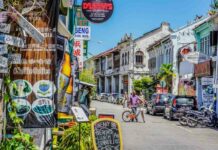
“I’m glad I spent time at Kek Lok Si Temple because it provided a nice change of pace,” explained Will Fly for Food blogger JB Macatulad after traveling there in search of a “legendary street vendor stand.” and it was diverted towards the Temple itself. “It was quiet and the weather was mild, quite different from the hustle and bustle of George Town.”
The history of Ke Lok Si temple
Driven by the need to build a shrine for Buddhist practice in Penang, the head monk of the Pitt Street Goddess of Mercy Temple proposed (and helped raise funds for) Kek Lok Si.
The foundation stone for Kek Lok Si was first laid in 1893. Penang’s leading Chinese Hakka magnates were cordoned off to provide financial support; Cheong Fatt Tze (whose home is still in George Town) contributed generously.
The opening of the temple in 1905 was blessed with a stone tablet and 70,000 copies of the Imperial Edition of the Buddhist Sutras by the Manchu Emperor Guangxu, who died three years later.
Construction never stopped at Kek Lok Si. The most iconic part of the temple, the 10,000 Buddha Pagoda, was not built until 1930. The 100-foot-tall statue of Kuan Yin , Goddess of Mercy , was added to the temple in 2002. Construction of an elaborate shelter around the La statue continues even today, funded by the Malaysian Chinese community.
Visiting Ke Lok Si Temple
On any given day, Kek Lok Si is a bustling hive of activity, underscored by the proliferation of statues, halls of worship, and ponds scattered across the grounds. Not really known for muted colors, the palette at Kek Lok Si leans toward gloss, just bordering on flashy.
JB Macatulad himself was struck by “all the pink statues of Buddha with swastikas on their chest.” (Note that these symbols do not reflect any anti-Semitic sentiment; the Nazis appropriated the symbol from the Buddhists, not the other way around.)
“I found that the temple attracted attention in good ways and bad,” explained JR. “In order not to be disrespectful, many parts were beautiful, but I found some elements a bit cheesy.”
While Kek Lok Si is a popular tourist attraction, JB cautions visitors to remember that this is also an active worship site. “When I was there, most of the visitors were pilgrims, it was more than just a sightseeing tour for them,” recalls JB. “It was obvious because they would pray before the statues and give offerings.”
The pagoda of 10,000 buddhas
Aside from the bronze statue of Kuan Yin, the 10,000 Buddha Pagoda is Kek Lok Si’s biggest draw, and its structure encapsulates the design clutter you’ll find in the rest of the complex.
Also known as Ban Po That , the official name of the pagoda is “Rama VI Pagoda” because the namesake king of Thailand laid the foundation stone. With a Chinese-inspired base, a medium Thai level, and a Burmese spire, the pagoda represents a mix of Mahayana and Theravada Buddhist beliefs rarely seen in Southeast Asian temples.
At 291 feet, the pagoda has become an iconic image in Penang. Inside, the continued patronage of the Thai royal family is manifested in a statue of the Buddha donated by the late King Bhumibol Adulyadej.
Finding good food around Kek Lok Si
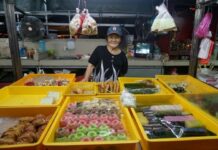
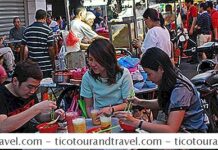
Given its secluded nature, Kek Lok Si is not as famous for its food options as other places closer to George Town’s tourist district. But food bloggers know better; ask JB Macatulad, for whom the food came first, the temple later.
“We probably wouldn’t have made the trip to Kek Lok Si if it hadn’t been for Air Itam Assam Laksa and Sister Curry Mee, ” JB confessed. “Food is a big reason we travel, so our intention was to visit these two legendary street vendor stalls.”
Those hawker stalls are awesome.
«[Air Itam Assam Laksa] has been selling their Assam laksa for more than 30 years, while the two sisters [who run Sister Curry Mee] have been offering their bowls of curry mee at the same roadside stand for more than 70 years, ”says JB. . “That is amazing.”
Chinese New Year at Kek Lok Si
The Chinese New Year in Penang is celebrated with extreme enthusiasm at Kek Lok Si. During the New Year’s celebrations, the entire complex is illuminated with thousands of lanterns, each representing a donation from supporters and devotees. These days, lanterns number in the tens of thousands.
If you can’t time your visit with Chinese New Year, try visiting the temple at sunset for amazing photo opportunities.
Arriving at Kek Lok Si Temple
Kek Lok Si is located about 40 minutes outside of Georgetown in Penang, Malaysia. Take bus # 201, # 203, # 204, or any signed Air Itam bus from the Komtar shopping complex in Georgetown.
Once you’ve disembarked at Air Itam Village, ask how to get to Kek Lok Si, or walk through the market to the hillside temple.
Many travelers choose to pay a visit to the strange Serpent Temple, or even a two-hour hike to Balik Pulau, when they visit Kek Lok Si.
Entrance to Kek Lok Si is free, but there is a small entrance fee to enter the 10,000 Buddha Pagoda. The inclined elevator to the Kuan Yin statue also charges a fee.