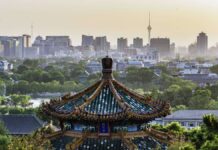
Named one of China’s World Cultural Heritage Sites by UNESCO in 1987, the Forbidden City is probably China’s best-known museum. Its famous red walls housed the Ming and Qing emperors for almost 500 years. Now the corridors, gardens, pavilions and almost a million treasures are visited and seen by millions of tourists every year.
What you will see
Don’t be fooled by the word “museum” in the official name. You won’t visit anything like a standard museum where treasures are housed inside glass boxes and visitors archive from room to room.
A visit to the Palace Museum is more like a very long walk from one huge plaza to another huge plaza divided by peeking into different official and residential buildings where the court and its henchmen ruled and lived.
The Forbidden City is located in the heart of Beijing, directly north of Tiananmen Square.
History of the forbidden city
The third Ming emperor, Yongle, built the Forbidden City from 1406 to 1420, when he moved his capital from Nanjing to Beijing. Twenty-four successive Ming and Qing emperors ruled from the palace until 1911, when the Qing dynasty fell. Puyi, the last emperor, was allowed to live within the inner courtyard until his expulsion in 1924. Then a committee took over the palace and, after organizing more than a million treasures, the committee opened the Palace Museum to the public on October 10. , 1925.
Characteristics
- Surrounded by 10 m high walls and a 52 m wide moat.
- It measures 961m from north to south and 753k from east to west, covering 720,000 square meters
- Each side has a door. Today’s tourists enter through the southern gate of the meridian (Wu men) and exit through the northern gate of spiritual value (Shenwu men).
- 70 halls and palaces, a total of 9,999 rooms comprise the palace spanning a north-south axis
- Multiple galleries showing parts of the imperial treasury
Services
- Multi-language audio guides are available at the Meridian Gate (Wu men) and Gate of Divine Prowess (Shenwu men). The rental requires a deposit that you will recover when you hand over our audio guide on departure.
- Check luggage at Meridian Gate, Wumen (but you will have to return to get it at the end of your trip).
- Gift shops, bookstores, sandwiches (there used to be a Starbucks, located in the southeast corner of the Preserve Harmony Room, but it has been replaced by something local)
- Information Center in the Archery Pavilion (Jian Ting)
Essential information
- Public buses that stop in the Forbidden City: 1, 4, 20, 52, 57, 101, 103, 109, 111
- Metro stops: Tian’anmenxi or Tian’anmendong on the East-West line
- Opening hours: every day throughout the year (closes a little earlier in winter)
- Recommended time for the visit: at least three hours.
Tips for visiting the forbidden city
- Visitors enter the Forbidden City from Tian’anmen Square through the great red wall with Mao’s portrait hanging on it. This is the southern end of the palace and you will walk the length of the complex to the northern end. It is not a round trip, but a long exploration through the complex. Consider that when meeting people or checking bags. If you need to return to Tian’anmen Square after your visit, it will be another long walk (or a short taxi ride) back.
- Wear comfortable shoes and think about sun protection. The walk itself, with nominal stops to look at the buildings, will likely take 2-3 hours. There are few opportunities to sit and rest and very little shade.
- Consider taking a guided tour. You’ll get a lot more out of your experience if you know what all the buildings were for and what happened in them. Otherwise it is just a series of similar buildings separated by long walks through large squares.
- If you haven’t come with a guided tour, consider an audio tour. Even if you feel like you’re missing every opportunity to rent one of these, wait for Roger Moore’s narrated audio guide. Worth it.
- As you enter the Meridian Gate, keep an eye out for shops selling a lovely map of the Imperial Palace. If you want a good memory, take this now. Unlike 99% of other souvenirs in China where you see the same things over and over again, you will only see this map in the shop at the beginning of the Forbidden City tour.