One of the longest-lived genres of video games that is still in top form is that of FPS ( First-person shooter ), those first-person-view shooter games that became popular as a result of id Software’s Wolfenstein 3D in 1992, exploding shortly after to the beast with the brutal DOOM the following year.
Since then, the FPS lived its golden age with the appearance of more iconic sagas, such as Duke Nukem 3D, Quake, Unreal or Half-Life, seeing how little by little other elements were introduced, such as puzzles or a greater weight for the story , Portal being another of the references, in this case of the First-Person Puzzler . But there is a very curious fact about first-person shooters developed in Japan : that there are practically none worth mentioning.
FPS developed in Japan? Where? When?
If we stick to pure First-Person Shooter , Japan is a far cry from Western fashion. Without going any further, he prefers rail shooters such as The House of the Dead, Time Crisis, Virtua Cop and other arcade classics.
What’s more, he hasn’t shaken his pulse when trying spin-offs of fetish sagas, such as Resident Evil, as happened with the mediocre Resident Evil Survivor of the first PlayStation, halfway between shooters on rails, but controlling (barely) movement. In fact, there was even a Silent Hill Arcade by Konami that resembled The House of the Dead.
But going back to Capcom’s survival horror , as much as on certain occasions the play did go well, as in Resident Evil 7: Biohazard, it was not essentially a shooter , but rather a horror adventure with a first-person view. and with parts of shots (especially in the final section). When the Osaka company opted for another side of shooter, with the option of a timid first-person view under the guise of Third-Person Shooter , the result was resounding, as in the nefarious Umbrella Corps. And all for failing to control .
If the classics of the 90s that we mentioned at the beginning still stand out, it is that they have a bomb-proof gameplay, with a fascinating immediacy that is most addictive, especially when playing against other people. This, unfortunately, does not apply (in general terms) to the majority of FPS of Japanese origin, with a more crude control that is not intuitive.
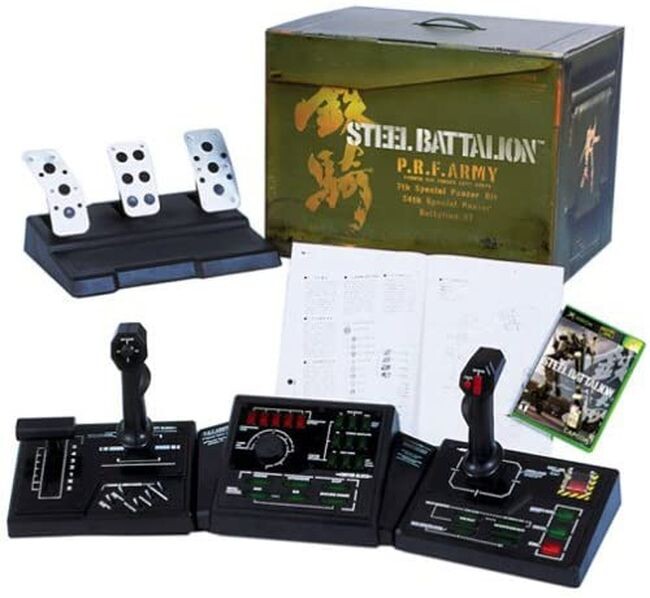
Steel Battalion, an Xbox exclusive brown beast. And a very careful hulk.
Part of that fault is the fact of mixing the traditional movement with mechanics more typical of shooters on rails, which translates into a less rewarding mix in terms of gameplay, despite the impact of such a piece of furniture. And another part of that fault is the fact of creating many games about Mechas, with a mobility far from the frenzy of the icons of 3D Realms, id Software or Epic Games. The story changes a lot.
Let’s think, without going any further, in that Steel Battalion by Capcom, another of the great forgotten exclusives of the first Xbox, which surprised by its accessory included with the game box: a mixture of panels with buttons, joysticks and pedals to control the player. Titanic Mecha. It was the typical game that had to be studied, reading the manual, like the old aerial combat simulators, before starting to play. And, of course, today it is quite a collector’s item.
Ironically, already with its third installment, this time for Xbox 360, From Software (yes, those from Demon’s Souls) took over with Steel Battalion: Heavy Armor and opted for an exclusive control with Kinect, resulting in a disastrous experience. It is true that it was an extreme case, but it serves to reflect the enormous commitment of Japanese studios when facing a first-person shooter , wanting to differentiate themselves from the pre-established guidelines .
A very poor background in one more RPG sector
If we leave popular sagas in Japan, such as Mobile Suit Gundam , which has had some chapters in the form of FPS, it is frankly difficult to think of games developed in the Japanese country under that premise, being that SEGA Outtrigger one of the first that they come to mind, despite offering the option between both views (first and third). The bad? That 1999 arcade, which was later released for Dreamcast in 2001, had to compete against Quake III Arena.
And who won? It is clear that the id Software classic, which premiered on the SEGA console in 2000. Not forgetting that Dreamcast also enjoyed Unreal Tournament in 2001. That is why the SEGA AM2 work had it impossible to start. But it is that its reception is not that it was a marvel, with some media calling it remarkable scraping. And personally, I don’t have good memories of this SEGA shooter , mainly because of the cumbersome control.
Since the irruption of the previous generation of 32-bit consoles, the genre lived its heyday in the shadow of the PC, until 64 and 128-bit consoles made it clear that there could also be good FPS with a controller, such as GoldenEye 007, Perfect Dark or Halo: Combat Evolved. But of course, these games are Western. In the mid-nineties, rarities such as Jumping Flash (PlayStation, 1995) came out, included in the mini-console PlayStation Classic, games that bet more on the vein of terror, such as Enemy Zero (Saturn, 1996) or directly forgettable like the lazy Iron Angel of the Apocalypse (3DO, 1994).
Whenever an attempt was made to replicate the classic formula, it was lost and those games were relegated to oblivion, while those that took risks did not catch on in the West. Apart from that until a decade ago, games that inherited the formula of shooters on rails, but offering freedom of movement, continued to happen. In fact, even Time Crisis 4 itself, in its home version for PS3 , offered a special FPS mode. It was a logical step to follow.
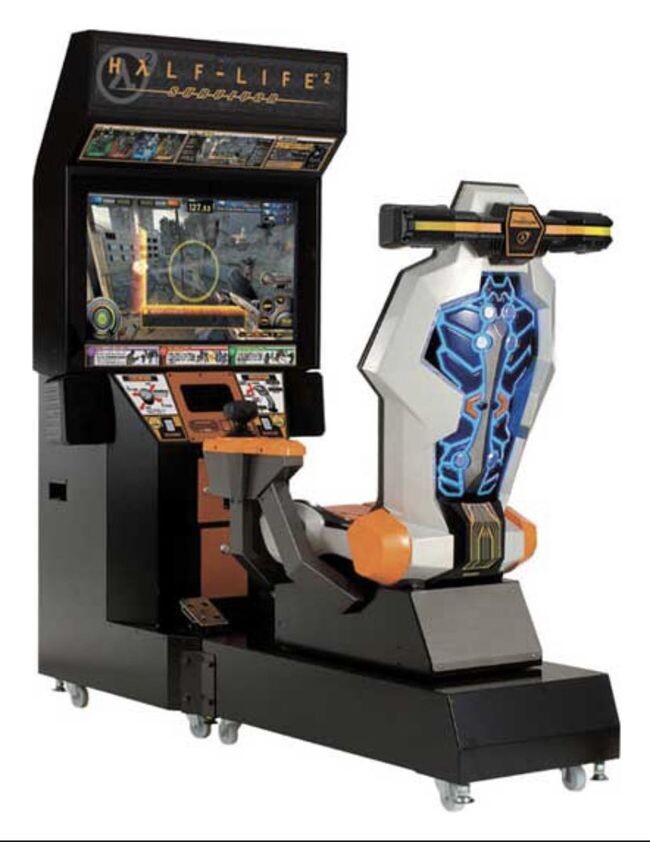
The curious thing, in any case, came from a western franchise, such as Half-Life , seeing how the historic Taito Corporation developed, in alliance with Valve, an arcade called Half-Life 2: Survivor , where the use of pedals and two levers, which was much more cumbersome than the classic mouse + keyboard. Obviously, it was exclusive to the Japanese territory, enjoying a sequel just the following year, in 2007. Yes, the year of the brutal The Orange Box .
Throughout the 21st century we have seen more first-person shooters with Japanese development, such as the one recently incorporated to Games with Gold, Breakdown , which Namco launched exclusively for Xbox in 2004. Or that Onslaught that many of us forgot about WiiWare in 2009, to charge of Hudson Soft, three years before the closure of the Japanese studio to become part of Konami. Even Elebits (Wii, 2006) can be considered FPS, no matter how childish it is. And very Japanese, yes.
Two of the last FPS from the country of the rising Sun that obtained some visibility are, in addition, two games that do not hide their origin, especially in that manganime aesthetic, especially in the case of The Legend of Alfur , which Playism edited in 2014 for PC and whose trailer you have below. The other, The Citadel , debuted on Steam in 2020 for 12.49 euros, drawing a lot of attention due to the contrast between characters and settings with the spirit of the 90s.
Definitely, I’m still sticking with the Western FPS , but if you’re curious, the Hardcore Gaming 101 forum has compiled a list of all the Japanese First-Person Shooters , despite some making the cut very fair. There are rarities that I did not know, such as Lucky & Wild (like a Chase HQ, but in FPS plan) or Crime Crackers , among other unknown more.