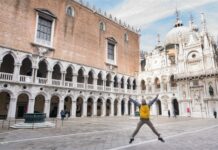
The Doge’s Palace, which dominates the Piazzetta from St. Mark’s Square (Piazza San Marco), is one of the main attractions in Venice. Also called Palazzo Ducale, the Doge’s Palace was the seat of power for the Venetian Republic, La Serenissima , for centuries.
The Doge’s Palace was the residence of the Doge (the ruler of Venice) and also housed the political bodies of the state, including the Grand Council (Maggior Consiglio) and the Council of Ten. Inside the luxurious complex, there were law courts, administrative offices, courtyards, grand staircases, and ballrooms, as well as prisons on the ground floor. Other prison cells were located across the canal in Prigioni Nuove (New Prisons), built in the late 16th century and connected to the palace via the Bridge of Sighs.
You can see the Bridge of Sighs, the torture chamber, and other sites that are not open to visitors on the Doge’s Palace Secret Itineraries Tour.
Historical records indicate that the first Doge’s Palace in Venice was built in the late 10th century, but much of this Byzantine part of the palace fell victim to later reconstruction efforts. Construction of the most recognizable part of the palace, the southern Gothic-style waterfront façade, began in 1340 in order to maintain the meeting chamber for the Grand Council.
There were numerous expansions of the Doge’s Palace throughout subsequent centuries, including after 1574 and 1577, when fires devastated parts of the building. Great Venetian architects, such as Filippo Calendar and Antonio Rizzo, as well as the masters of Venetian painting, Tintoretto, Tiziano, and Veronese, contributed to the elaborate interior design.
The most important secular building in Venice, the Doge’s Palace, was the home and seat of the Republic of Venice for approximately 700 years until 1797, when the city fell to Napoleon. It has been a public museum since 1923.