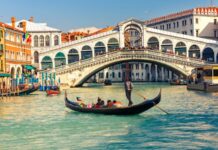
The arched Rialto Bridge, or Ponte di Rialto, is central to Venice’s history and is now one of the most famous bridges in Venice, if not the world, and one of Venice’s top attractions.
This was the first of only four bridges that today span the Grand Canal:
- Ponte dell Accademia, rebuilt in 1985
- Ponte degli Scalzi, built in 1934
- The modern Ponte della Costituzione, or Ponte di Calatrava, built in 2008 and designed by the famous Spanish architect Santiago Calatrava.
- And the 500-year-old stone Rialto Bridge, lined with shops on both sides. As such, the 16th century Rialto Bridge is by far the oldest bridge on the Grand Canal, dividing the districts of San Marco and San Polo.
At the mall
The bridge gets its name from the Rialto, the first district of Venice that developed when people began to settle here in the 9th century. It didn’t take long for the area to become the commercial and financial center of a flourishing city. The bridge is also a gateway to the Rialto Market, a maze of vendors in the west of the country that sells produce, spices, fish and more, and the city’s main food market since the 11th century.
Before the construction of the Rialto Bridge at the end of the 16th century, a series of bridges occupied this natural crossing, the so-called “lazy curve” of the Grand Canal and its narrowest point. Because this bridge was the only place to cross the Grand Canal on foot, it was imperative to build a bridge that would withstand heavy use and also allow ships to pass under it.
Beginning in 1524, artists and architects, including Sansovino, Palladio, and Michelangelo (yes, that Michelangelo) began submitting plans for the new bridge. But no plan was chosen until 1588, when the municipal architect Antonio da Ponte received the commission. Interestingly, da Ponte was the uncle of Antonio Contino, the architect of Venice’s other unmistakable bridge, The Bridge of Sighs that connected the doge’s palace to the prison.
The Rialto Bridge today
The Rialto Bridge is an elegant arched stone bridge made up of three sets of stairs divided by arcades. The central stairs are lined with shops and vendors and are so thickly packed that it is easy to miss the fact that you are crossing the Grand Canal. These stores occupy some of the most expensive real estate in Venice, so while it’s good to say you bought a souvenir on the Rialto Bridge, this isn’t the cheapest place to find your souvenir of Venice.
The other two stairs, on the north and south sides of the bridge. They offer those iconic views of the Grand Canal, with gondolas, vaporetti and commercial boats passing by day and night. It’s still pretty crowded on any of the steps, but it’s worth taking a moment to snap some photos of this unforgettable scene. At sunset, especially, there are few more beautiful and romantic places to be in Venice.
On both sides of the Rialto Bridge, you will find restaurants along the canal that offer spectacular views of the bridge. You’ll also find spectacular prices on the menu, and not necessarily the best cuisine in Venice. Our advice is to walk a little further in the Rialto district (in the direction of St. Mark’s) and look for some of the most authentic taverns and restaurants in the dense maze of streets and alleys. You may not get a million dollar view, but you will have better food.
This article was updated and expanded by Elizabeth Heath.