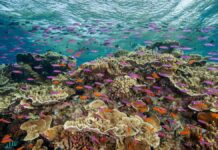
Without a doubt, the Great Barrier Reef, which stretches off the Queensland coast, is home to the most magnificent marine life you have ever seen. With countless ways to explore the reef, including helicopter rides, snorkeling, scuba diving, and just lazing on a sunny beach surrounding the coral wonderland, the Great Barrier Reef should definitely be on your travel list.
Do you still need to convince? Here are 19 surprising facts about the Great Barrier Reef, all of which are great reasons to plan a visit!
- The Reef attracts more than two million visitors each year, making it Australia’s most popular tourist attraction.
- The Great Barrier Reef is made up of more than 2,900 individual reefs and 900 islands, although only a handful of the islands are populated.
- The reef is surprisingly easy to access – it can be reached from many different parts of Queensland. Tours and day trips run regularly from Cairns, Port Douglas, Townsville and Hamilton Island.
- The reef is so big that it can be seen from space!
- It is the only natural structure visible from the moon.
- If you are more of a sea person, you can sail to the reef; Cruises depart regularly from Brisbane and Sydney. You can take a short 4-day tour to try out, or enjoy your inner explorer and opt for a 10-day cruise.
- At 2,300 kilometers, or 1,429 miles in length, the Great Barrier Reef is the longest coral reef in the world. The second longest, the Belize Reef off the Caribbean coast of Belize, is only 290 kilometers long.
- It is the largest living structure on the planet.
- Hamilton Island, the largest island in the Great Barrier Reef archipelago, is the only island that has a commercial airport, making it easily accessible by plane.
- Covering around 344,400 square kilometers, or 133,000 square miles, the Great Barrier Reef is larger than Italy.
- The barrier reef is one of the most boisterous ecosystems in the world, with more than 1,500 different types of fish. That is about 10% of all known species of fish.
- The Reef is estimated to be around 18 million years old, although no one knows its age for sure.
- Since 1985, environmental damage and pollution have seen more than half of the coral on the reef die. Since then, conservation efforts have helped reduce damage to the reef.
- Although it may be tempting, it is a criminal offense to remove any coral from the reef; a strict “look, but don’t touch” rule applies.
- The 2008 film “Fool’s Gold,” starring Kate Hudson and Matthew McConaughey, was filmed in part on the reef.
- Along with the Grand Canyon in the United States and Mount Everest in Nepal, the Great Barrier Reef has the prestigious honor of being named one of the Seven Natural Wonders of the World. Rounding out the list are Victoria Falls, a sudden-falling waterfall in southern Africa on the Zambezi River; the Paricutín volcano in Mexico; the natural lights of Aurora in the Arctic and Antarctic regions; and the Guanabara Bay in Rio de Janeiro.
- The Great Barrier Reef is located within the Great Barrier Reef Marine Park, a World Heritage Site, the only underwater national park. The reef itself only covers about 7% of the marine park.
- In addition to some of the most unique and beautiful marine animals on the planet, the Great Barrier Reef is also home to the box jellyfish, blue-ringed octopus, and stonefish, some of the most poisonous marine animals we know of.
- While indigenous Australian aborigines have been aware of the reef for some 40,000 years, the first European to notice the Great Barrier Reef was the French explorer Louis de Bougainville, in 1768.