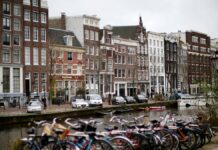
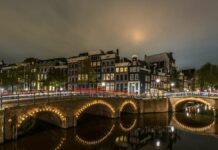
When visitors to Amsterdam first set foot on Dam Square, or wander the sprawling Museumplein, or have a drink on one of the café terraces on Leidseplein or Rembrandtplein, it soon becomes clear how much of the city is structured around the unit. of the plein or square. The following squares are the ones that visitors are likely to see on their trip, and for good reason: many of the city’s most memorable destinations can be found in one of these picturesque squares.
Plaza Dam
Amsterdam’s iconic square, Dam Square, or simply “de Dam” in Dutch, is the first stop on many visitors’ itineraries, especially due to its proximity to Amsterdam Central Station. Newcomers meet the mass of people heading to Damrak, a street perpetually lined with souvenir shops, restaurants (most of which are best avoided), and little else. The street stretches out onto Dam Square, where a trifecta of classic attractions awaits: the National Monument to the east, and the Royal Palace and Nieuwe Kerk (New Church) to the west.
Leidseplein
Leidsestraat (Leiden Street), historically the main road to Leiden, culminates at Leidseplein (Leiden Square), one of Amsterdam’s most vibrant entertainment districts. Cafes, bars, clubs, and restaurants line the square’s perimeter, and street performers try to draw an audience from the crowds of people heading to their dinners and shows. Some of the best music venues in the city are located near the Leidseplein, such as Paradiso, whose concert calendar features many internationally renowned artists, and venues for all tastes can be found in and around the square. The seasonal side of Leidseplein is one of its most famous benefits: from a skating rink in winter to a carpet of café terraces in warmer months, the square rolls with the seasons. Not far from Leidseplein is the Vondelpark, so visitors in search of a place of peace will find this to be a respite from the exceptionally lively square.
Mint Square
More of an intersection than a square proper, Muntplein (Mint Square) is special for its historic architecture and its convenient location amid some of the city’s most unique attractions. The namesake Munttoren (Mint Tower) towers over the busy intersection, where passersby occasionally stop to admire the classic architecture of the old 17th-century mint. To the west, the stalls of the world famous Bloemenmarkt (flower market) stretch along the canal. To the north, shoppers poll the Kalverstraat commercial for popular international brands. Both the bars and clubs of the Rembrandtplein and the more understated attractions of the Waterlooplein are close by.
Museum Square
Perhaps the widest of Amsterdam’s squares, the Museumplein (Museum Square) is appropriately named after the two main museums located on its vast lawns, in addition to the many other attractions close to the square. The beauty of the square’s landscape matches that of the museum’s architecture, which comprises the Van Gogh Museum, one of Amsterdam’s most popular museums, dedicated to the troublesome artist, his brilliant work and his contemporaries, and the Stedelijk Museum, The Amsterdam museum of modern art, which is currently undergoing renovation. (The museum continues to host exhibits and events in borrowed exhibition spaces.) The Rijksmuseum’s stellar collection is nearby, as well as the Coster Diamonds headquarters, offering tours of their facilities to diamond enthusiasts.
Continue to 5 of 9 below.
New Market
Located in the heart of Amsterdam’s Chinatown, Nieuwmarkt (New Market) square is the scene of many annual celebrations, especially New Years Eve and Chinese New Years. The perimeter of the square is lined with cafes, restaurants and coffee shops, whose terraces take over the sidewalks in the warmer months; Restaurants vary wildly, from the Nyonya Malaysia Express Chinese-Malay restaurant to the Swiss fondue specialist Cafe Bern, a rarity in Amsterdam. At the center of the square is De Waag, it was built in 1488 and has served various purposes over the centuries, the most recent of which is a cafe and restaurant.
Noordermarkt
Located in the attractive Jordaan district, the Noordermarkt (North Market) is perhaps most famous today for its farmers market on Saturdays (9 a.m. to 5 p.m.), attracting shoppers from across the city and beyond. with its excellent selection of products, meats, cheeses and more. Cafes and restaurants have sprung up in the plaza to cater to the market crowds and other visitors. The square takes its name from Noorderkerk, the church on the site, which actually used part of the square as a cemetery until the mid-17th century; no trace of this previous use remains. Much later in its history, Dutch activists protested the deportation of Jews in this square; a plaque in the church remembers these activists and the Jews who were eventually deported despite their valiant efforts.
Rembrandtplein
Rembrandt Square’s claim to fame is similar to that of Leidseplein: cafes, bars and clubs are often the destinations of choice for those on the Rembrandtplein, but the atmosphere is unique and different from that of their peers. This may be due in part to the statue of the Dutch master who patrols the square, but also to the individual character of his businesses. Both the plaza and its side streets are home to a variety of clubs: some chic establishments for clubbers who like to dress up, others laid-back for those who prefer to dress up, and one: the XtraCold Ice Bar – Where revelers are best dressed warm. One side of the square features a huge interactive video screen (25 ‘x 49’) that can be controlled with Bluetooth-enabled phones. Moviegoers will want to see the nearby Pathé Tuchinski Cinema, a beautiful architectural landmark that has shown films since 1921.
The Spui
Het Spui, or “The Sluice” in Dutch, is a prime spot for bibliophiles: several major bookstores line the square, from the Brain Athenaeum to the attractive interior of the American Book Center, a multi-story bookstore with an excellent selection. . Plus, on Fridays, a used book market takes over the square, with rows of old, hard-to-find titles, and cheap old, plain books. The literary cafes complete the book atmosphere of the square. Look out for the statue called Het Lieverdtje (“The Sweetheart”), which represents the youth of Amsterdam; The Provo youth movement of the 1960s, which often used this square as a venue for protests against corporations, would gather at this statue. At the end of a side street, almost opposite the American Book Center, is the famous Vleminckx Sausmeesters, touted as the best fries in Amsterdam.
Continue to 9 of 9 below.
Waterlooplein
The star of Waterlooplein (Waterloo Square) is the Stopera, whose name is an acronym for its two inhabitants: Stadhuis (Town Hall) and Opera. While the Stadhuis is of limited use to most visitors, the opera is the home theater of De Nederlandse Opera, the Dutch national opera company, whose performance seasons are marked by an impressive array of operas, from traditional standards. even lesser-known contemporary works. The plaza is home to an almost daily flea market filled with second-hand clothes, accessories, and other used items, turning the spacious premises into a maze of vendors; The market is open 6 days a week and closed on Sundays and holidays, when the square tends to seem ominously empty compared to its usual hustle and bustle. Waterlooplein is situated in Jodenbuurt, the old Jewish quarter, and a grim black monument stands in one corner to commemorate the resistance efforts of Jewish citizens; Just a few steps away are some of the many Jewish sites in Amsterdam, such as the wonderful Joods Historisch Museum.