Venice, often called the ‘City of Canals’, and the ‘Floating City’, is also known as the ‘City of Bridges’ due to the many stretches that cross its waterways. While many of Venice’s more than 400 bridges are indescribable and practical, many embody the beauty and history of this fascinating city.
Here are the bridges to look for on a trip to Venice.
01
of 08
Bridge of Sighs
Direction
Piazza San Marco, 1, 30122 Venice VE, ItalyGet directions
Telephone
+39 041 271 5911
Web
Visit the website
This infamous walkway connects the Doge’s Palace with the Prigioni (prisons). Although many visitors find this bridge and its name romantic, it offered the prisoners of the Venetian Republic a final chance to see the city before they were taken to their cells or the executioner. The Italian name for the Bridge of Sighs is Ponte dei Sospiri . The canal under the bridge is one of the most popular kissing spots in Venice.
02
of 08
Rialto bridge
Direction
Sestiere San Polo, 30125 Venice VE, ItalyGet directions
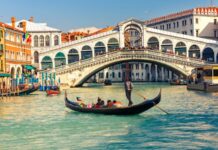
As famous as the Bridge of Sighs and equally photogenic, the Rialto Bridge is the main pedestrian crossing over the Grand Canal. Rows of shops line this wide arched bridge and the famous Rialto food and fish market is nearby.
03
of 08
Academy bridge
Direction
30123 Venice, Metropolitan City of Venice, ItalyGet directions
The Accademia Bridge (Ponte dell Accademia) is so named because it crosses the Grand Canal at the Galleria dell Accademia, one of the best museums in Venice.
While the Ponte dell Accademia is not a new bridge, it was first erected in the mid 19th century and then replaced in the 1930s, it is interesting for its high arch construction and the fact that it is made of wood. The current Academy Bridge dates from 1985, when the 1930s bridge was rebuilt after being deemed too dangerous.
04
of 08
Puente Barefoot
Direction
Ponte degli Scalzi, 30135 Venice VE, ItalyGet directions
Named for the nearby Chiesa degli Scalzi, literally the “church of the barefoot monks,” the Scalzi Bridge is an elegant stretch of stone that links the Santa Croce and Cannaregio neighborhoods.
The Scalzi Bridge dates from 1934 and is one of four bridges over the Grand Canal. If you arrive in Venice by train at Santa Lucia Station, the Scalzi Bridge will be one of the first bridges you will cross after disembarking.
Continue to 5 of 8 below.
05
of 08
Calatrava bridge
Direction
Constitution Bridge, 30135 Venice VE, ItalyGet directions
Telephone
+39 041 274 8111
Web
Visit the website
Completed in 2008, the Calatrava Bridge was designed by the Spanish architect Santiago Calatrava. The last of the four bridges spanning the Grand Canal, the Calatrava Bridge, has been a controversial addition to Venice’s architectural landscape due to its modern appearance, its cost (approximately 10 million euros), and its necessity. However, the bridge, whose official name is Ponte della Constituzione, has served one purpose: it links the Santa Lucia train station with Piazzale Roma, a bus station and parking lot.
06
of 08
Bridge of the Spiers
Direction
Ponte delle Guglie, 30121 Venice VE, ItalyGet directions
The Ponte delle Guglie is one of the two bridges that span the Cannaregio Canal, located at its western end, near where it joins the Grand Canal. It is close to the Venezia Santa Lucia train station, not far from the Rialto bridge. This stone and brick bridge has ornate decoration, including gargoyles, on its arch. It is also known as the “Bridge of Towers” due to its metal spiers (the only bridge in Venice with this architectural detail).
07
of 08
Ponte della Paglia
Direction
30124 Venice, Metropolitan City of Venice, ItalyGet directions
If you want to see the Bridge of Sighs, the best vantage point is this bridge, which dates back to 1847. Local folklore says that the bridge gets its name because ships used to dock it to carry their load of Paglia (straw) in Venice.
08
of 08
Ponte della Liberta
Direction
Ponte della Libertà, 30135 Venice VE, ItalyGet directions
This bridge connects the mainland with the islands that make up the center of the city of Venice. The Ponte della Liberta used to be known as the Ponte Littorio. It was inaugurated by the Italian dictator Benito Mussolini in 1933 and renamed after World War II to mark the liberation of Italy from fascism. If you arrive at the Venezia Santa Lucia station by train, you will first cross this bridge.