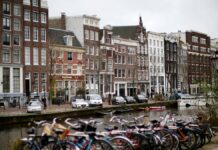
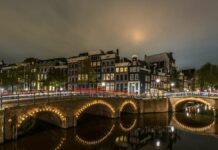
As the Zeedijk undulates from Prins Hendrikkade (Prince Hendrik Quay) in the north to Nieuwmarkt square in the southeast, it’s hard to see what awaits at every hairpin turn in the street, a row of restaurants, bars and cafes, toko’s ( not Europen supermarkets) and boutiques. Despite the diversity of the street, visitors are often surprised to stumble upon the He Hua Buddhist Temple, located at a bow on the winding road, and whose traditional Chinese palace architecture towers over the narrow street. What is the history of this temple, which contrasts with the typical Dutch architecture of the historic street?
The He Hua Buddhist Temple, whose name translates to “Lotus Flower,” opened its doors in 2000 as a center for humanistic Buddhism, which seeks to weave Buddhist spirituality into the daily lives of its practitioners. The Chinese name also echoes the temple’s mission to educate the Dutch public about Buddhism, as the first syllable in “He Hua” is the same as in “He Lan,” the Chinese name for Holland. To this end, the temple is free to enter, and volunteers are available to offer tours and provide information to curious minds of any nationality.
The entrance to the temple complex is a series of three adjacent arches, a number that has rich symbolism to Buddhists; the central one is traditionally reserved for the use of monks and nuns, the two smaller ones for lay people. Above, the glowing tiles and animal statues, representing the Chinese zodiac, are the product of Chinese art; However, the tiles have not done so well in the Dutch climate, and are now wrapped in the net to catch the debris that dislodges. The hybrid facades on both sides of the temple proper are used to ease the transition from the lavish palace architecture to the Dutch townhouses, and blend elements from both sides of the spectrum.
The entrance at the top of the stone stairs leads visitors to the central shrine, dedicated to Kuan Yin (sometimes referred to as the “Goddess of Mercy”), one of the major bodhisattvas of East Asian Buddhism; on either side of her are the dharma protectors Wei Tuo and Qie Lan. The Śākyamuni shrine is dedicated to Siddhartha Gautama, the historical Buddha; Just as the image of Kuan Yin is repeated in the reliefs on the wall of the main shrine, so is the image of Buddha in the dozens of identical statues in the Śākyamuni shrine, a repetition that is intended to evoke the omnipresence of “universal Buddha nature” , an important tenet of East Asian Buddhism.
Devotees offer incense or fruit to the two deities, and the aroma of the incense permeates the shrines.
Visitors are invited to explore the temple at their own pace, or they can take advantage of the half-hour tours offered on Saturdays at 3, 4, and 5 p.m. Additionally, the temple hosts special events and activities for the public throughout the year. , both in the temple itself and in the nearby Nieuwmarkt square; These include the celebration of Vesākha, the “birthday of Buddha,” whose date on the lunar calendar generally falls in May. See the Activities section of the He Hua Buddhist Temple website for a list of what’s going on.
Hua Hua Temple Visitor Information:
Hua Hua Buddhist temple location
Zeedijk 106 – 118
Opening hours
- Tue – Sat 12 – 5 pm
- Sun 10 am – 5 pm
- Closed Monday and January 1st.
Entrance: Free
Go there
- On foot : From the south side of Amsterdam Central Station, follow Prins Hendrikkade east until it forks towards Zeedijk; The temple is on the west side of the street.
More information
The Buddhist temple of Hua
website