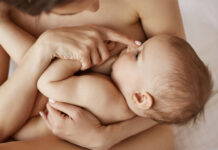
Skin-to-skin contact with the newborn in the first moments of life is very beneficial for both the short and long term. This early contact between the mother and the baby that has just been born, in a calm environment, recognizing each other, is one of the most intense moments that a mother can experience.
How to practice skin-to-skin with the newborn
It doesn’t have much science. The important thing is that the baby is in contact with his mother’s bare chest, so he must be placed with his belly close to your chest . Preferably, the baby has to be without clothes, with a diaper, and we can cover his back with a blanket so that he does not get cold.
You will have to support the baby with one hand by bringing his heels together, adopting the position he had inside the uterus, and placing the other hand on his back.
Along with smell, touch is one of the most developed senses in the baby at birth, so being close to you, feeling your body heat and receiving your caresses is the best place where it can be.
Whether the baby is premature or full-term, this practice strengthens the emotional bond between the two.
Why is it best for the newborn
The skin-to-skin, or Kangaroo Method, emerged years ago in hospitals that did not have incubators available for all premature babies, and the results of this practice far exceeded the expectations of doctors in the recovery of the little ones.
Today its benefits are indisputable, and it is always recommended to put the newborn in skin-to-skin contact with his mother at the time of birth and whenever possible. Among its great advantages, we can find:
- Improves your vital signs : the baby’s heart rate and breathing rate becomes more stable.
- Helps regulate body temperature : in the first hours of life, the newborn does not yet have the thermoregulation mechanisms adjusted.
- Better adaptation to the environment : after leaving the mother’s womb, mother’s breast is the place most similar to where it has been for the last nine months.
- Helps you calm down : Mom’s breast gives her peace of mind and security, reducing the stress of birth. Skin-to-skin is related to a shorter duration of the baby’s cry, compared to newborns who did not have skin-to-skin contact with their mothers.
- Improves pain tolerance : recent studies show that it reduces the brain response of newborns to pain, recommending that the first medical tests such as the Apgar test at the time of delivery, as well as later the heel test or during vaccination , put the baby skin-to-skin.
- It favors breastfeeding : the closeness to the breast, favors that the baby is attracted to the breast by the smell and latches on spontaneously.
- Long-term benefits : the trust and love that is transmitted to the baby when practicing skin-to-skin is an experience that will influence the development of their emotional intelligence and the way they establish social relationships with other people.
It is also the best for the mother. Skin-to-skin contact with your newborn baby activates the brain to produce endorphins, which increase feelings of well-being, and oxytocin, known as the love hormone, which is related to affection and bonding.
Let them not be separated
The first hour of life is sacred to mother and baby. It favors early contact between the two , helping to establish an affective bond that is deeply engraved in your brain.
But after birth, skin-to-skin contact is still very important, so it should be encouraged whenever possible, even if the baby is no longer so small. And of course, it is a practice that the parent is also recommended to do. Remember that the arms and the protection provided by caregivers is a basic need of babies, as much as eating or sleeping.
In Babies and more | “What happens in childbirth is deeply engraved in both brains.” Interview with Ibone Olza