For some forty years, the site now known as the Berlin-Hohenschönhausen Memorial was not even marked on maps, it was that secret. While the DDR was in power, this prison complex was where people simply disappeared.
While I was there on a sunny day, listening to a young American guide tell us about the many cruelties that occurred here, it all seemed unreal. The semi-abandoned buildings looked abandoned, not sinister. But there is little doubt that this place still inspires interest in East Berlin’s dark past. Since the monument’s establishment in 1994, more than 2 million people have visited.
History of Hohenschönhausen
The site was opened as the Hohenschönausen Redemption Prison in 1946. The Soviets used it to interrogate suspected Nazis and collaborators. Once a “confession” was extracted, many of the prisoners were sent to the nearby Sachsenhausen prison camp.
In 1951, the prison became the property of the Stasi. People turned to their neighbors, friends and family with one informant for every 180 citizens. Many of the people handed over by informants ended up in Hohenschönhausen.
Political dissidents, critics, and people trying to flee the East Germans were subjected to physical and mental atrocities. Kidnapped from their homes without trial, they were found guilty and psychologically beaten until they admitted their wrongdoing. If you need help imagining this, imagine the confession scenes in “The Lives of Others” that were based on real-life events in prison.
The site was closed on October 3rd, 1990 and unlike many institutions in Germany of the East, Hohenschönhausen was initially left intact. Unfortunately, this gave the prison authorities time to destroy much of the evidence from the prison’s history. Most of what we know about the site comes from the eyewitness accounts of former prisoners.
In order to preserve what was left, former inmates formed a foundation to list it as a historic site in 1992 and it was reopened as a memorial in 1994.
Tours de Hohenschoenhausen
Gedenkstätte Berlin-Hohenschönhausen is now available to visit by guided tour. Visitors can see the grounds, the rooms where prisoners were held and interrogated, and hear first-hand accounts from former prisoners who occasionally give tours.
Prison sections
Transportation : The psychological games began before the suspects entered the prison. Vehicles used to capture soon-to-be prisoners are on display. They appeared to be typical grocery or service vans, but were specially equipped to lock suspects inside without windows. It was a common tactic to pick up people directly from the street and drive hours around town to confuse the prisoners. Not only did they have no idea where they were, their friends and family would have no idea where they were taken.
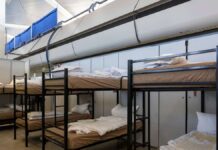
U-Boot – Known as the Submarine due to its subterranean and wet location, this is the oldest section of the prison used primarily by the Soviets. Up to twelve prisoners were packed into small cells with a large wooden bed to share, a trash can for the bathroom, and no access to the outside world.
Stasi Prison – A new building added in the late 1950s, built by inmate workers, became the Stasi Prison. Its bleak gray interior contains 200 prison cells and interrogation rooms. Long corridors are equipped with red lights and alarms that allowed guards to signal when the corridor was used so that prisoners would never be found. In the cells, books, writing and talking were not allowed.
Center Console – All aspects of the prison can be controlled from this area. The guards frequently used the controls to psychologically manipulate prisoners by turning lights off and on, flushing toilets, and generally depriving prisoners of any rest.
- Website : http://www.stiftung-hsh.de/
- Hours : Guided tours in English, French, Spanish, Italian, Danish and Norwegian, every day from 9:00 a.m. to 4:00 p.m. English speaking tours every day 10:30 am, 12:30 pm and 2:30 pm.
- Admission : 5 euros (2.50 for university students, retirees, disabled or Berlinpass holders or 1 euro for students)
- Address : Genslerstraße 66, 13055 Berlin
- How to get there : trams M5, M6, 16 or bus 256. It is between 5-10 minutes walk from the stops.
- Telephone : 030 98608230